

(日本語ブログ:効果的なIRが企業価値の差を生む理由|One World Link)
In our previous blog, we discussed a resurfaced video in which Peter Thiel, chair of Palantir Technologies, briefly discussed the level of impact the expansion of AI may have on people in math-related fields versus those in more writing-based fields.
We dived into a Wall Street Journal article that then discussed the rise in corporations searching to communicate more through “storytelling.”
Today, let’s take that discussion one step further and talk about why effective storytelling in investor relations can become a competitive advantage.
Why Narrative Matters in IR
Investors do not evaluate companies based on numbers alone.
Sure, financial metrics are essential, but investors also need to understand the strategy behind those numbers.
Studies show that investor relations communication and more frequent engagement can improve company valuation, liquidity, and institutional ownership. (*IDEAS / RePEc journal article)
In other words, a good narrative can influence how the market perceives a company.
This narrative is often called a company’s equity story and connects several key elements:
- Business strategy
- Competitive positioning
- Growth opportunities
- Capital allocation decisions
- Long-term value creation
Let’s take a look at a report by Corbin Advisors titled Maximizing Valuation Through Strategic Investor Communication. Corbin Advisors is a U.S. company that provides strategic advisory services in investor relations and communications, supporting publicly traded companies in building sustainable shareholder value. In this article, the company highlights how important effective communication has become in modern capital markets.
Based on more than 24,000 interviews with the investment community, the research by Corbin Advisors suggests that roughly 40% of a company’s valuation can be influenced by investor relations and communication, either positively or negatively. The same study also found that companies perceived to combine strong execution with strong communication significantly outperform peers in share price appreciation. (Corbin Advisors PDF)
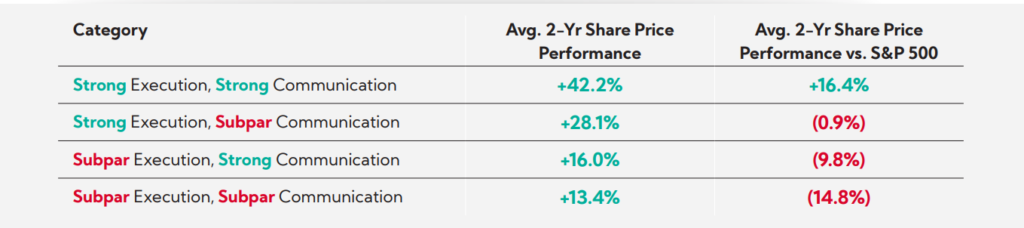
Corbin Advisors, Maximizing Valuation Through Strategic Investor Communication, 2025
In a market where investors follow dozens of companies at once and face an overwhelming amount of information, a clear and compelling investment story can play a major role in capturing investor attention and building long-term confidence. If you are interested in learning more, the full report is worth reading here.
The Growing Use of AI in Corporate Communication
In recent years, an increasing number of companies are looking to AI to cut costs and increase efficiency. In the world of investor relations, this shift can look like reducing personnel and internalizing translation by relying on AI tools or generative translation instead of outsourcing work to professional translators or communications specialists.
But relying on AI tools and generative translation in corporate writing runs the risk of companies losing their narrative and originality in repetitive, second-hand output.
At first glance, relying on AI and cutting personnel may seem efficient. AI tools can quickly generate English text from Japanese source material. They can summarize information and produce draft translations in seconds. However, there is a risk that companies relying heavily on AI may gradually lose their original voice and narrative.
When many organizations use similar tools and prompts, the output often becomes repetitive. Over time, corporate messaging can begin to sound standardized, generic, and indistinguishable from competitors.
The Hurdle of Japanese-to-English
Japanese and English are extremely different languages to translate between. From sentence structure to word choice, and even the tone of business materials, writing clear and effective communication takes more than direct translation.
Japanese business writing tends to rely on long sentences, indirect structure, and implied subjects. English investor communications, on the other hand, typically prefer result-first structures, clear subjects, and active voice.
Using large language models to translate often produces English that mirrors Japanese sentence structures. The translation may be technically correct, but the output frequently reads like a direct, one-to-one translation.
This type of English can be difficult for international investors to read. Following the Japanese structure too closely can make your message too hard to understand, resulting in less effective communication.
Another factor worth considering is the growing number of frameworks and guidelines used in sustainability and ESG reporting. Standards from organizations such as the ISSB, GRI, and TCFD often encourage companies to disclose similar types of information using similar terminology. As a result, sustainability sections in many reports can begin to sound almost identical once translated into English.
Following these guidelines is essential. However, you still have flexibility in how you communicate your message.
Clear and concise writing can often convey the same information in fewer words while highlighting your unique strategy and strengths. Communicating the same required disclosures more clearly and effectively than other companies can create an opportunity to differentiate your company in the eyes of global investors.
Differentiation Through Communication
Modern investors face an overwhelming amount of information, with institutional investors often following dozens of companies at the same time.
Companies that communicate clearly and consistently can stand out more easily in this environment.
Strong investor communication helps companies in the following areas:
- Build trust with investors
- Explain complex strategies clearly
- Differentiate themselves from competitors
- Attract long-term shareholders
Companies that invest in strong storytelling can therefore gain an advantage over companies that rely on generic communication.
The Plain English Approach
One practical way to improve IR communication is by adopting Plain English.
Plain English focuses on clarity and accessibility, making it a strong choice for companies communicating with a global audience. This writing approach began as a way to make government and legal documents easier for the public to understand. One World Link encourages companies to apply the same approach to communicate more clearly and effectively with global investors and stakeholders.
Check out our previous blogs on Plain English here. Make sure to stay tuned for upcoming posts where we take a deeper look at what Plain English is and how to apply this approach in practice.
In Summary
An increasing number of companies are looking to AI and generative translation tools for translation. But effective investor relations is not simply about speed and quantity—it’s about the quality of your message and differentiating your narrative from your competitors.
Companies that invest in effective communication and professional writing can strengthen investor understanding, build trust, and differentiate themselves in global capital markets.



Jessica Azumaya
最新記事 by Jessica Azumaya (全て見る)
- Before You Draft: Writing With Purpose in Business and Investor Relations Communications - 8月 7, 2026
- Writing for a Global Audience - 6月 2, 2026
- What Makes Business English “Business”? - 5月 9, 2026
- How Effective IR Can Be a Competitive Advantage - 4月 10, 2026
- The Rise of Storytelling in the Era of AI - 3月 27, 2026