One World Link (OWL) specializes in delivering precise and effective English translations for corporate communication. With over 14 years of experience in investor relations and corporate communications, OWL helps Japanese companies build stronger relationships with global investors. From earnings reports and financial statements to executive messages and ESG narratives, OWL provides accurate and professional translations tailored to the needs of publicly traded companies. By providing clear and effective corporate messaging, OWL helps bridge communication gaps and foster trust and understanding between Japanese companies and global stakeholders.
One World Link offers free English business writing assessments for publicly disclosed English materials. To request a free assessment, visit https://oneworldlink.jp/satei.php#contact or call 03-5534-9011.
As your company begins drafting annual reports, take a moment to consider the final English translation.
You may think that planning for the translation stage is too early, especially if you haven’t yet drafted the original Japanese. However, this stage is the most effective time to think about translation.
Strong English output does not depend only on translation skills. A well-structured Japanese draft plays an equally important role. More logical Japanese leads to more logical English. Weak structure in your source text can appear in the English version, regardless of how skilled the translator is.
Let’s take a look at three core elements you should consider before you draft any investor relations materials: audience, objective, and outcome.
1. Audience
Identify your audience. Who will read your document?
Defining your primary reader allows you to shape the tone, terminology, and level of explanation in your report.
Primary readers include institutional investors, analysts, and overseas stakeholders, each with different expectations and levels of familiarity with your company. At the same time, your report may reach a broader audience, including global employees.
“If you’re not an investor, but an employee working within a corporation, the annual report can impart valuable information pertinent to your career. Understanding how your company is performing and the impact your actions have had on its business objectives can help you advocate for a promotion or other form of career advancement.”
Although this article addresses business school students and company employees, the takeaway here is that your audience might include more than those who are experts in finances, market analysis, and company valuation.
If you choose to write for a broader audience, focus on clear structure and accessible language. Avoid unnecessary complexity by limiting the use of lesser-known industry terms, overly complex financial language, internal terminology, and acronyms or abbreviations without context. Present information in a way that allows first-time readers to follow your narrative without needing to stress.
2. Objective
Clarify what your document needs to achieve.
The same Harvard Business School Online article explains that annual reports are unlike other pieces of financial data in that these reports are used as marketing collateral and include editorial elements and storytelling.
In other words, an annual report does not exist to present information alone. These reports should communicate financial performance, strategy, and a consistent narrative across all aspects of the business. But without a clear objective, the main message can become buried under information that does not guide the reader toward a single idea.
Clarifying your objective in each section of the report can help you avoid weighing down the Japanese with descriptions without purpose.
For example, if your company experienced a significant decrease in earnings, the financial review section may focus on explaining the key drivers behind that change, while the CEO message or individual business segment sections may reinforce how the company plans to increase earnings again.
Defining this intent in advance helps ensure that your narrative stays clear and consistent throughout the report.
3. Outcome
Define what you want your reader to think, understand, or do after reading.
Will your annual report shape how investors understand your growth drivers? Do you want analysts to model future performance with greater confidence? Or is your goal to build trust in your strategy and execution?
Ensure every section moves your reader toward this outcome. Section headers, titles, and word choice across the report should support the same direction.
A clear theme can help achieve this. See our blog on themes to understand why a strong theme can support your narrative and help ensure readers understand the takeaway.
The Takeaway
Define your audience, objective, and outcome before drafting. This step improves both your Japanese source text and your final English output. Strong investors relations communication depends on clarity of intent, not just language skills.
When you take time to structure your message before writing, you produce reports that investors can understand quickly and trust more easily.
When preparing earnings materials, disclosures, or other investor communications in English, do you think about your global audience? Do you consider whether stakeholders from different countries and cultural backgrounds will be able to follow the logic and messaging clearly?
Your audience likely includes readers with different English proficiency levels, cultural backgrounds, and communication styles. Understanding how to write for a global audience can help make investor communications clearer, more accessible, and easier to understand across markets.
One approach that can help companies communicate more effectively with global audiences is Plain English.
In today’s blog, we will provide a more in-depth look at the Plain English approach, explore why tis method of writing was originally developed, and examine several rewrite examples that demonstrate how clearer writing can improve communication with global audiences.
The Plain English Approach
One World Link prioritizes using Plain English in our translations and we encourage companies to apply the same principles when communicating with global investors and stakeholders. But what exactly is Plain English?
In a recent blog on how effective IR communications are a competitive advantage, we briefly introduced Plain English as a writing approach that focuses on clear, accessible communication. The approach originally developed as a way to make government and legal documents easier for the public to understand.
This approach can be especially important when communicating with global audiences. English proficiency levels, cultural backgrounds, and communication styles can differ significantly across readers, making clarity and accessibility an important part of effective global communication.
Many of the principles associated with Plain English also overlap with the points we covered in our previous blog on Business English writing:
Write short, direct sentences
Use simple language and avoid idioms or slang
Make correct grammar and punctuation a priority
Be clear in your messages
Include strong vocabulary
Be careful when using industry-specific language or internal language
The following examples break down several Plain English rewrites based on these Business English writing principles and demonstrate how small adjustments can make corporate communications clearer and easier for global audiences to understand.
Write short and direct sentences
Japanese sentences often contain multiple clauses and background explanations. Direct translations can therefore become long and difficult to read.
Ex.
English: In order to further strengthen our management foundation and realize sustainable growth over the medium to long term, we will continue to implement initiatives aimed at improving operational efficiency throughout the Group.
Rewrite: We will continue to improve operational efficiency across the Group to strengthen our management foundation and support medium- to long-term growth.
Why rewrite?
“In order to” and “further” add words, but do not add meaning.
The original sentence contains a long introductory clause and several layers of explanation before reaching the main point.
The phrase “implement initiatives aimed at improving” is weak. Changing to “improve” is more direct and concise.
Use simple language; avoid idioms or slang
Idioms depend on cultural familiarity. Global readers who speak English as a second language may not immediately understand the meaning.
Ex.
English: Our new strategy is a game-changer for the company.
Rewrite: Our new strategy will completely transform our [XYZ].
Why rewrite?
The phrase “game changer” is an idiom that some global investors might not understand. Using simpler phrasing that keeps the same impact helps ensure understanding for all readers.
Use correct grammar and punctuation
Though a bit obvious, grammar and punctuation should be a priority, instead of bending English rules to match the Japanese structure.
For example, English only uses quotation marks in limited situations. Quotation marks are not a simple translation for every use of Japanese brackets.
Ex.
English: The company implements initiatives under the concept of “value creation.”
Rewrite: The company implements initiatives focused on value creation.
Why rewrite?
We use quotation marks for direct quotes, titles, unusual terminology, and even sarcasm in English. We never use quotation marks to emphasize a word or a phrase.
Ensure clarity
Japanese writing, in particular, tends to omit subjects and use passive language frequently. These habits, while perhaps acceptable for Japanese readers, negatively impact readability and clarity in English.”
Ex.
English: The results of deliberations are reported to the Executive Committee and incorporated into the company strategy.
Rewrite: The Board of Directors reports deliberation results to the Executive Committee, which translates results into the company strategy.
Why rewrite?
The original uses passive voice, which hides who performs what actions. Clarity is key in governance reporting. Be sure to use subjects and keep sentences simple to ensure clarity.
Using strong vocabulary
Japanese writing often relies on verb-noun structures, which AI and machine translation tend to render as indirect, verb-heavy phrases in English.
Some of the most common examples come from する verbs, which often appear as weak verb constructions in English, such as conduct, implement, and develop. Phrases like “conduct a share repurchase” or “implement a merger” can be written more concisely and naturally as “repurchase shares” or “merge” in most contexts.
Another common pattern is the use of nominalizations. Nominalizations, or verbs expressed as nouns, often create long and wordy phrases that reduce clarity. For example, “contribute to the enhancement of corporate value” can be simplified to “(help) enhance corporate value,” and “conduct an evaluation of risks” can be rewritten as “evaluate risks.”
Direct translations of verbs such as realize, promote, and strengthen can also sound vague or unnatural, as their usage differs from typical English contexts.
A plain English approach favors using a single, strong verb to keep sentences clear and concise.
Ex.
English: The company will contribute to the realization of a sustainable society.
Rewrite: The company will help build a sustainable society.
Why rewrite?
“Contribute to” is a weak verb that does not explain the company’s action.
“Realization of” is problematic on a few levels.
First, we want to avoid nominalizations when possible.
Word choice. Realization is not natural in this context.
Another area in which OWL recommends using strong verbs is in place of adverbs and weak verbs. Business Japanese relies on many adverbs that we can remove and rewrite into stronger verbs.
Ex.
English: We will further strengthen efforts to expand overseas operations.
Rewrite: We will strengthen efforts to expand overseas operations.
Why rewrite?
Words such as expand, strengthen, improve, increase, enhance, and develop already imply movement or progress. Adding “further” often repeats the same idea without adding meaningful information.
Conclusion
Ensuring your message is clear to people across the world is the number one way to write for a global audience. Simplicity is key.
Contact OWL and let us help you tell your story to the world.
I’m sure you’ve heard the term “business English” many times in your career. From finance and government to multinational corporations, business English appears across a wide range of formal workplace settings.
Emails, proposals, reports, presentations, and meeting materials are just a few media you might associate the term with. But what actually makes business English “business”?
Let’s look at how established institutions define business English, what characteristics distinguish it from general English, and how those principles apply in practice. Then, let’s consider why audience awareness is especially important when communicating with your company’s stakeholders.
Definition
Indeed, a global employment platform, published a career development article that defines business English as “a type of writing that focuses on clearer, more direct language without slang, idioms, or grammatical errors.”(Indeed Career Guide)
The article further dives into how business English carries stricter expectations for vocabulary, grammar, and sentence structure, explaining, “Clarity and consistency are important components of business English, which is why it focuses so heavily on things like strong vocabulary and well-written sentences.” (Indeed Career Guide)
Pearson, a multinational education company known for publishing textbooks, academic materials, and various types of other English language training content, also frames business English in a similar way, stating:
“Business writing refers to the clear and purposeful use of language in written form within a professional context. It encompasses a wide range of documents, including emails, reports, proposals and presentations, tailored to communicate effectively with clients, colleagues and stakeholders.”
Across these definitions, several themes emerge consistently: clarity, correctness, structure, and purpose.
Core Attributes of Business English
Based on these definitions, business English rests on a few core pillars:
Clarity
Correctness
Direct language
Consistency
But how can you communicate with these attributes in mind?
The Indeed article outlines several practical things to keep in mind when writing business English communications:
Write short, direct sentences
Use simple language and avoid idioms or slang
Make correct grammar and punctuation a priority
Be clear in your messages
Include strong vocabulary
In contrast, Japanese corporate writing is rooted in cultural communication norms that can prioritize context building, careful explanation, and layered messaging before presenting conclusions.
This approach can be the antithesis of many Business English writing practices and requires translators to exercise care when translating Japanese content into English.
Let’s take a look at how business English practices are applied. Consider the following example from a typical earnings report.
Ex. 1
Original: Company Name Co., Ltd. (Securities code: 0000; the “Company”) hereby announces that XXX Co., Ltd. has resolved, at its meeting of the Board of Directors held on MM DD, YYYY, to acquire the shares of the Company through tender offer as described in the attachment.
This is an example of an English translation from a JPX disclosure template on a notice concerning a tender offer of shares.
As you can see, the sentence is overloaded with information and is hard to read.
We can make this a bit easier to read by restructuring the sentence and making small edits to word choice to improve clarity.
Rewrite: Company Name Co., Ltd. (Securities code: 0000; the “Company”) announced that the XXX Co., Ltd. Board of Directors approved a resolution to acquire shares of the Company via tender offer, as described in the attached materials. The meeting in question was held on MM DD, YYYY.
Here’s another example.
Ex. 2
Original: Although the electronic component business saw lower average selling prices resulting from inventory adjustments by customers in the previous fiscal year, demand grew for high-value-added power management ICs for semiconductor applications, mainly in Europe, and operating efficiency improved due to cost reduction efforts, resulting in higher sales.
This sentence is an example of the type of structures and wording we come across quite often in direct Japanese-to-English translation at One World Link. Notice how the overall outcome (“sales increased”) doesn’t appear until the end of the sentence, buried beneath a lengthy explanation.
While this style of writing is more typical in Japanese, it creates run-on sentences and muddles the intent to report on the results.
How can we make this information clearer to readers? Let’s take a look at how writers at OWL might rewrite this sentence into business English.
Revised: Sales increased in the electronic component business. despite lower average selling prices in the previous fiscal year due to customer inventory adjustments. This result reflects strong demand for high-value-added power management ICs for semiconductors in Europe and stronger operating efficiency driven by cost reductions.
Again, the first thing we would do is bring the result to the forefront of the sentence.
We would then rework the “why” and the “how” to support this result. The original example is overloaded, cramming both positive and negative factors into the same sentence. Our revision breaks down this sentence into two clearer, more direct pieces of information.
Notice also how “resulting from inventory adjustments by customers” becomes “due to customer inventory adjustments,” and “cost reduction efforts” becomes “cost reductions.” Rewriting overly complicated structures to stronger and more direct verbs is a great way to enhance readability.
It’s important to note that while Ex. 1 and Ex. 2 deal with long sentences, making adjustments to smaller sentences is still equally important in business English.
Let’s take a look at the next two examples to see how we can improve clarity in shorter sentences.
Ex. 3
Original: We are working to contribute to the promotion of sustainability through our business activities.
Revised: We support sustainability through our business activities.
This example is highly common in Japanese-to-English translation. Weak phrases like “working to contribute to” and “the promotion of,” which mirror Japanese expressions such as 貢献 and 推進. While the original sentence is grammatically correct, the structure is incredibly confusing and unnecessarily long. Remember, business English prefers clear, direct sentence structures with strong vocabulary. “We support” expresses the same idea in a way that aligns with business English writing conventions.
Another noteworthy change involves the verb form. Literal translations often use -ing constructions because Japanese frequently uses progressive expressions like 取り組んでいます or 推進しています. In English business writing, however, the simple present tense is usually stronger and clearer.
Ex. 4
Original: Our Group is promoting initiatives such as reducing environmental impact and contributing to local communities in order to realize a sustainable society.
Revised: The Group supports a sustainable society by reducing environmental impact and contributing to local communities.
This is an example of a typical AI translation of Japanese that we might come across. As we discussed above, the revision changes the verb form to simple present tense and moves the main idea forward. The revision also addresses a few issues that make the original writing sound like a direct translation.
1. “Our Group”
“Our Group” is technically incorrect. We capitalize Group only when it replaces the company’s proper name. In this sentence, “group” is a general noun, so lowercase is correct. If you want to reflect 当社グループ in English disclosure writing, “The Group” is the appropriate expression.
2. “is promoting initiatives”
“Promoting” is a direct translation of 推進. In English business writing, however, companies do not usually “promote initiatives.” The verb sounds unnatural in this context and does not clearly describe the action. Stronger alternatives include pursue, implement, or carry out, depending on the meaning of the original sentence.
3. “in order to”
“In order to” is often used in literal translations of Japanese text. In most cases, “to” communicates the same meaning more clearly and concisely. Shorter phrasing improves readability and aligns with common Business English writing practices.
Ex. 5
Original: Net sales increased significantly by 28.5% year on year as a result of the expansion of sales in overseas markets and the strengthening of product competitiveness.
Revised: Net sales rose 28.5% year on year, driven by higher overseas sales and stronger product competitiveness.
This sentence is something we might see in a quarterly earnings report.
Like Ex. 3, the original translation here is much simpler than Ex. 1 and Ex. 2. Being short, however, doesn’t automatically mean the sentence is direct or clear. There are still areas in which we can use stronger, more concise vocabulary.
Japanese writing often relies on verb-noun structures, which AI and machine translation tend to render as indirect, verb-heavy phrases in English. Some phrases appearing often in Japanese to English translation include sentences ending in 〜の実施, 〜の強化, or 〜の推進. AI and machine translation often render these phrases as nominalizations like “the implementation of,” “the strengthening of,” or “the advancement of.”
Such phrases and nominalization weigh down the sentence and impact readability. Replacing “the expansion of sales in overseas markets” with “higher overseas sales” results in a more concise and direct message.
Business English in the Financial Sector
Business English applies across industries, but tailoring your writing to your audience is essential.
Investor relations communications differ from general corporate writing, given that primary readers operate in financial markets. Institutional investors, analysts, and global shareholders review disclosures under time constraints. Many compare performance across multiple companies, industries, and jurisdictions in a single day. Instead of looking for emotional persuasion, they expect clear and accurate results, logical explanations, and consistent terminology.
Many U.S. corporations file their financial disclosures using Plain English to improve the clarity of disclosure documents, referencing the Securities and Exchange Commission’s Plain English Handbook 2011. The SEC encourages companies to use short sentences, active voice, concrete terms, and logical organization so investors can understand material information without unnecessary complexity.
Practice Makes Perfect
Writing business English is a major skill that takes time and practice to develop.
You can enhance your skills by reviewing examples, analyzing sentence structure, identifying weak verbs and nominalizations, and consistently asking one question: Does this sentence communicate the result clearly to the intended reader?
For more practice, follow One World Link on Facebook or LinkedIn, where we regularly share business English writing tips, examples, and short quizzes designed for professionals in corporate and financial communications.
A Caution When Using AI and Machine Translation
AI translation systems learn from large datasets of aligned sentence pairs, meaning these systems often mirror the structure of the Japanese source sentence instead of restructuring the input for natural English. As a result, the English output frequently retains Japanese writing patterns. Long sentences remain long, context appears before the main point, and conclusions often appear at the end.
If you rely on AI translation for Japanese reports, always check whether the English follows natural English writing conventions. You may need to implement the methods we discussed in this blog to shorten sentences, move key points earlier, or simplify explanations so overseas readers can quickly understand your message.
In our previous blog, we discussed a resurfaced video in which Peter Thiel, chair of Palantir Technologies, briefly discussed the level of impact the expansion of AI may have on people in math-related fields versus those in more writing-based fields.
We dived into a Wall Street Journal article that then discussed the rise in corporations searching to communicate more through “storytelling.”
Today, let’s take that discussion one step further and talk about why effective storytelling in investor relations can become a competitive advantage.
Why Narrative Matters in IR
Investors do not evaluate companies based on numbers alone.
Sure, financial metrics are essential, but investors also need to understand the strategy behind those numbers.
Studies show that investor relations communication and more frequent engagement can improve company valuation, liquidity, and institutional ownership. (*IDEAS / RePEc journal article)
In other words, a good narrative can influence how the market perceives a company.
This narrative is often called a company’s equity story and connects several key elements:
Business strategy
Competitive positioning
Growth opportunities
Capital allocation decisions
Long-term value creation
Let’s take a look at a report by Corbin Advisors titled Maximizing Valuation Through Strategic Investor Communication. Corbin Advisors is a U.S. company that provides strategic advisory services in investor relations and communications, supporting publicly traded companies in building sustainable shareholder value. In this article, the company highlights how important effective communication has become in modern capital markets.
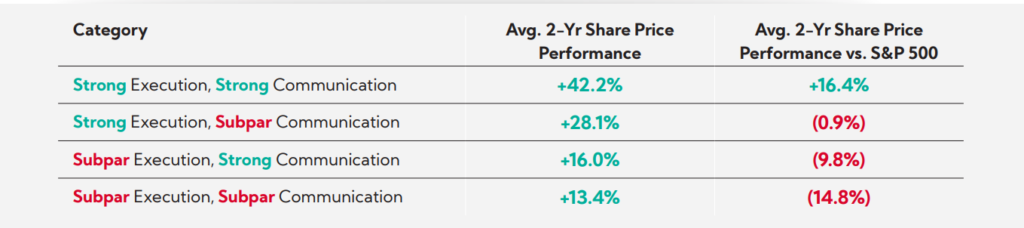
Based on more than 24,000 interviews with the investment community, the research by Corbin Advisors suggests that roughly 40% of a company’s valuation can be influenced by investor relations and communication, either positively or negatively. The same study also found that companies perceived to combine strong execution with strong communication significantly outperform peers in share price appreciation. (Corbin Advisors PDF)
Corbin Advisors, Maximizing Valuation Through Strategic Investor Communication, 2025
In a market where investors follow dozens of companies at once and face an overwhelming amount of information, a clear and compelling investment story can play a major role in capturing investor attention and building long-term confidence. If you are interested in learning more, the full report is worth reading here.
The Growing Use of AI in Corporate Communication
In recent years, an increasing number of companies are looking to AI to cut costs and increase efficiency. In the world of investor relations, this shift can look like reducing personnel and internalizing translation by relying on AI tools or generative translation instead of outsourcing work to professional translators or communications specialists.
But relying on AI tools and generative translation in corporate writing runs the risk of companies losing their narrative and originality in repetitive, second-hand output.
At first glance, relying on AI and cutting personnel may seem efficient. AI tools can quickly generate English text from Japanese source material. They can summarize information and produce draft translations in seconds. However, there is a risk that companies relying heavily on AI may gradually lose their original voice and narrative.
When many organizations use similar tools and prompts, the output often becomes repetitive. Over time, corporate messaging can begin to sound standardized, generic, and indistinguishable from competitors.
The Hurdle of Japanese-to-English
Japanese and English are extremely different languages to translate between. From sentence structure to word choice, and even the tone of business materials, writing clear and effective communication takes more than direct translation.
Japanese business writing tends to rely on long sentences, indirect structure, and implied subjects. English investor communications, on the other hand, typically prefer result-first structures, clear subjects, and active voice.
Using large language models to translate often produces English that mirrors Japanese sentence structures. The translation may be technically correct, but the output frequently reads like a direct, one-to-one translation.
This type of English can be difficult for international investors to read. Following the Japanese structure too closely can make your message too hard to understand, resulting in less effective communication.
Another factor worth considering is the growing number of frameworks and guidelines used in sustainability and ESG reporting. Standards from organizations such as the ISSB, GRI, and TCFD often encourage companies to disclose similar types of information using similar terminology. As a result, sustainability sections in many reports can begin to sound almost identical once translated into English.
Following these guidelines is essential. However, you still have flexibility in how you communicate your message.
Clear and concise writing can often convey the same information in fewer words while highlighting your unique strategy and strengths. Communicating the same required disclosures more clearly and effectively than other companies can create an opportunity to differentiate your company in the eyes of global investors.
Differentiation Through Communication
Modern investors face an overwhelming amount of information, with institutional investors often following dozens of companies at the same time.
Companies that communicate clearly and consistently can stand out more easily in this environment.
Strong investor communication helps companies in the following areas:
Build trust with investors
Explain complex strategies clearly
Differentiate themselves from competitors
Attract long-term shareholders
Companies that invest in strong storytelling can therefore gain an advantage over companies that rely on generic communication.
The Plain English Approach
One practical way to improve IR communication is by adopting Plain English.
Plain English focuses on clarity and accessibility, making it a strong choice for companies communicating with a global audience. This writing approach began as a way to make government and legal documents easier for the public to understand. One World Link encourages companies to apply the same approach to communicate more clearly and effectively with global investors and stakeholders.
Check out our previous blogs on Plain English here. Make sure to stay tuned for upcoming posts where we take a deeper look at what Plain English is and how to apply this approach in practice.
In Summary
An increasing number of companies are looking to AI and generative translation tools for translation. But effective investor relations is not simply about speed and quantity—it’s about the quality of your message and differentiating your narrative from your competitors.
Companies that invest in effective communication and professional writing can strengthen investor understanding, build trust, and differentiate themselves in global capital markets.
Recent data shows a clear rise in the use of the terms “storytelling” and “storyteller” in investor days and earnings calls among Western companies. Corporate job listings reflect the same shift, with more roles emphasizing storytelling as a required skill, even in an era increasingly shaped by AI. What do these companies mean by storytelling? What does storytelling have to do with you in your everyday investor relations work?
Some older comments on AI by Peter Thiel, chair of Palantir Technologies, have gained renewed attention over the past few months. In a discussion at the Mercatus Center on February 21, 2024, Thiel sat down with economist Tyler Cowen as part of the Conversations with Tyler podcast to discuss various topics from political theory to religion and AI.
The resurfaced clip from this interview shows Thiel stating, “It seems much worse for the math people more than word people. What people have told me that they think within the next 3-5 years, AI models would be able to solve all the US Maths Olympiad problems.” (*1)
In other words, Thiel theorized that the expansion of AI would affect those in math-related fields more than those in writing fields.
But why is this video resurfacing now?
While there is no single answer to this question, the video may be resurfacing due to a few factors.
In the U.S., AI has been a recent hot topic among banks and other financial institutions, with numerous companies announcing workforce cuts or the possibility of doing so due to AI in the near future. (*2) Furthermore, according to this Scientific American article (*3), certain AI models were able to solve five out of six questions during an unofficial 2025 International Math Olympiad test.
So, what about the “word people,” and do you even consider yourself “word people” as an IR professional? How does the expansion of AI affect those in corporate communications and other writing positions now?
In December 2025, the Wall Street Journal released an article on the importance of storytelling in corporate America. The article quotes numerous companies like Google and Microsoft that are searching for “storytellers.” (*4)
Specifically, the article states:
“Marketing and technology companies have often repurposed grandiose descriptions from other arenas to lend corporate office roles additional sparkle. While the heyday of technology gurus, developer ninjas, SEO rockstars and at least one digital prophet have long since passed, calling salaried communications professionals “storytellers” and the practice of storytelling appears to only have picked up in popularity.”
In other words, even as some question the value of traditional writing roles, companies continue to increase hiring for positions around storytelling. But what exactly is storytelling, and who are the storytellers?
Storytelling refers to communicating information in a way that connects ideas into a clear and engaging narrative, rather than presenting facts in isolation. Storytellers are the people who shape and deliver that narrative, deciding what to emphasize, how to structure information, and how to make the message clear and engaging for their audience.
In a corporate context, storytelling can be seen in the way we structure information to ensure that stakeholders understand the company’s strategy, performance, and direction as a coherent narrative.
Referring to this type of communication as “storytelling,” rather than terms such as “editorial” or “press relations,” has become increasingly common.
In fact, the Wall Street Journal notes that job postings on LinkedIn mentioning words like “storyteller” and “storytelling” doubled over the past year (Nov. 27, 2024 – Nov. 26, 2025). Listings for marketing positions were around 50,000 at the time of the WSJ article, while listings under media and communications came in at around 20,000.
The article also suggests possible reasons for this shift. Changes in how audiences consume information may play a role. Readers have moved away from traditional newspapers, and companies now communicate directly through their own channels, including social media.
These shifts may also influence how both audiences and companies approach communication, and in turn, how companies define and recruit for these roles.
FactSet, a financial data and analytics company, also reported an increase in the number of times the words “storyteller” and “storytelling” came up in investor days and earnings calls, with CEOs and companies also shifting away from terms “editorial” and “press relations strategy” to terms like “storytelling” and “content strategy.” (*4)
Jennifer Kuperman, chief corporate affairs officer of Chime, a financial technology company, says, “Terms like ‘editorial’ are limiting. They put in mind a very specific thing you’re doing or creating. Whereas you could tell stories in so many different ways—social, podcasts, putting your executives out there, hosting an event, talking to the press.” (*4)
Taken together, these trends suggest that companies increasingly view communication as a way to shape how stakeholders understand the business. For professionals in investor relations and corporate communications, this shift to storytelling raises expectations for how your company writes and presents English disclosures are written and presented.
The Takeaway
AI is evolving at breakneck speed, but increased reliance on AI also brings growing distrust and risks. Corporations appear to be turning towards more human and authentic communications to reach their target audiences, leading to a rise in demand for storytelling-focused roles.
While AI may be one step closer to solving the world’s most difficult math problems, as Peter Thiel previously suggested, humans are still an essential part of writing.
This shift places greater importance on how your company’s story is communicated in English. Disclosures must do more than present accurate information. They must connect key messages into a clear and coherent narrative in both the original and target languages.
At One World Link, we focus on telling your story to the world. Our Japanese-to-English writers support investor relations teams with professional translations that deliver clear, natural, and investor-ready narratives.
Reach out with any questions, and ensure your English narratives clearly support your story.
Citations
1. YouTube video Mercatus Center. (2024, April 17). Peter Thiel on political theology | Conversations with Tyler [Video]. YouTube. https://www.youtube.com/watch?v=vfbndRTlsg4
Do you use English in the design of your Japanese reports?
Whether you add English for branding, global appeal, or internal consistency across your disclosure materials, the final design should always be reviewed by a native English speaker before final publication.
Without that review, the English throughout your design may contain issues that only surface once translation begins. Revisions to the design at that stage can be extremely difficult and may affect both the Japanese and English versions of the report.
These challenges appear in many places, from katakana English to short English labels, English-based headings, taglines, and other forms of copywriting. Below, I dive into just a few of the most common examples we tend to see in Japanese IR and ESG reports.
Katakana English
Many English expressions in Japanese reports originate from katakana words or shorthand that work naturally in Japanese but do not carry the same clarity in English. Common examples include the following:
テーマ
Often mistranslated as theme. The translation depends heavily on context, but more accurate choices could include topics, discussion points, or focus areas.
インプット・アウトプット (Or similar headings)
Input and Output may be correct in certain contexts, but others require that these words take the plural form. Such Japanese words typically don’t take the plural form. Translating the katakana directly without confirming whether the context requires singular or plural can lead to confusion.
トップメッセージ
Top Message is a very common heading seen in Japanese reports, but it is not standard English for U.S. corporate communications. Natural alternatives include Message From the CEO or CEO Message, among other options.
While these translations aren’t necessarily incorrect, they can appear elementary, over literal, or even come across as a direct translation. When that English is already embedded into background elements or graphics, making adjustments becomes difficult. Early-stage consultation with a native English speaker or a trusted translation company helps prevent issues at the final production stage.
Typography
Typography is another important consideration when using English in Japanese reports. Fonts optimized for Japanese typography do not always handle English kerning or letter shapes well. Using English-optimize fonts is one way you can ensure your English looks professional across both Japanese and English reports. English optimized fonts can prevent wide kerning, unusual spacing, and inconsistencies between the Japanese and English versions of the report.
Below is an example of a single phrase using four different fonts. On the right side, I use Georgia and Arial fonts (English-optimized), and on the left side, I use 游ゴシック and メイリオ.
Notice how the spacing between each letter is slightly wider in the Japanese-optimized fonts. This spacing is called kerning. English becomes more polished when kerning remains tight and balanced. Japanese fonts also use wider ledding—the space between lines—to accommodate the taller structure of kanji and kana. Wider ledding can create unnecessary vertical space when the same font is used for English paragraphs.
Using English inside Japanese-language reports can strengthen your global image, but only when the English is accurate, natural, and typographically appropriate. Literal or improperly formatted English often needs revision during translation, and those revisions become difficult when the original layout has not accounted for English structure or typography.
Planning for English from the beginning improves both versions of the report. Clear, consistent English supports investor understanding and reflects the professionalism expected in IR communication.
One World Link can help review your English for Japanese layouts before reports reach the translation stage. Contact us today!
Direct translations of Japanese lists or items within the same hierarchy often overlook a crucial detail in English writing: parallel structure.
Parallel structure means aligning the grammar and form of each item in a list or group to ensure consistency. Literal translations of such items may reflect the original Japanese structure, but a lack of parallel structure can feel confusing or jarring in English.
High-quality English requires more than accuracy. A clear and consistent structure guides readers smoothly through key points, helping global audiences understand the information without hesitation.
Non-Parallel Structures
At OWL, we often see Japanese reports use non-parallel structures in lists and groups of phrases. Using a mix of verbs, nouns, gerunds, and other parts of speech in the same list may be acceptable Japanese writing, where readers can typically understand the message based on context. But English does not work the same way.
Inconsistent structure appears uneven and reduces readability, leading to communication issues in investor relations documents, where clarity and consistency are essential.
Take a look at the following Japanese-language example.
How would you translate this list? A direct, non-parallel translation might look like the following:
Take a look at item #3. Unlike the first two items, the phrase environmentally friendly activities does not include a verb. A missing verb here can be jarring to English readers, who may wonder what action your company intends to take regarding these activities.
Do you intend to engage in environmentally friendly activities? Increase participation in such activities? Start engaging? Continue current activities?
Ensuring parallel structure can support quick reading, reduce misinterpretation, highlight priorities clearly, and build trust through polished communication.
Items Within the Same Hierarchy
Items within the same hierarchy do not always appear as lists. A good example of this is a company’s materiality. Materialities have become a common reporting element across sustainability reports, ESG disclosures, and IR documents.
When laying out each materiality, ensure each item follows the same tense and grammatical structure, even if located in various similar areas throughout your report.
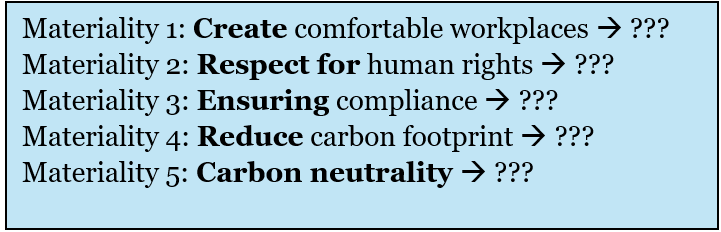
Let’s take a look at the following materialities.
Does each materiality use parallel structures? Or can you identify a mix of plain verbs, noun phrases, and gerunds? If there is a mix, how might you fix it?
If you answered that the materialities are not parallel, you would be correct. But how can you best fix this issue?
There are three simple approaches you can take.
Convert all plain verbs and gerunds (verbs taking “-ing”) into noun phrases
Convert all noun phrases and gerunds into plain verb phrases
Convert all nouns and verb phrases into gerunds
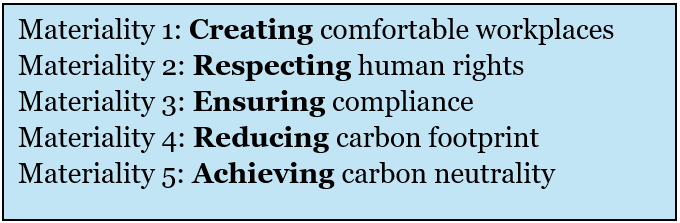
Let’s take a look at the following edited materialities.
Would you say the items in this group are parallel? The correct answer is yes.
Note that in my revision, I changed all forms into “-ing” verbs. Whether you revise your list to begin with plain verbs, “-ing” verbs, or nouns can boil down to preference, style, and even context.
The Takeaway
Literal translations can miss structural signals that matter in English. Ensuring parallel structure in English translations can lower miscommunication and ensure the intent of the Japanese is translated clearly.
Parallel structures across lists and items within the same hierarchy can also create a polished tone that supports trust and credibility with global investors through a clear structure that strengthens your message.
For support in creating consistent English writing, contact One World Link today
Integrated reports and sustainability reports carry significant responsibility in telling your story to a global audience. These documents communicate strategy, purpose, and progress to both domestic and global stakeholders, and every section contributes to the larger story that your company wants to tell. The key to shaping the story readers take away is the theme, or overarching message, that guides them through the report.
A theme isn’t just a cool slogan on the cover of your report. Instead, a theme should support your company’s values, philosophy, and the message of your overall report.
When the theme shifts from section to section, readers can struggle to understand the overall direction. Using a consistent theme will help keep your reports coherent and create a clear message investors can follow from the first page to the last.
A consistent theme can also only improve readability and enhance credibility. Investors expect companies to communicate with clarity, and a strong theme demonstrates intention and alignment across the organization.
Themes Across Sections
Consider the following example headings commonly found in an integrated report.
Cover Innovation for Growth
CEO Message Creating Stakeholder Value
ESG Section Building a Sustainable Future
Looking at these headings, readers might assume that each section discusses a different concept. Although all three sections may introduce valid talking points, the shift in focus can distract readers and make your report feel fragmented.
Below is an example of what a more consistent theme might look like, centered around the theme of innovativegrowth.
Cover Innovation for Growth
CEO Message Innovative Growth Builds Shareholder Value
ESG Section Innovative Growth Leads to a Sustainable Future
These revised section headings now link each message back to a single theme, creating not only consistency throughout the different sections but also strengthening the image that your company is fully dedicated to innovative growth.
When each section develops the same core idea, the entire report feels more intentional. Your theme supports the strategic story, and readers can see how leadership, ESG initiatives, and long-term ambitions connect to the company’s growth narrative.
This article on Storyraise (run by Storyraise Technology Inc.) discusses a multitude of reasons why developing a theme for your integrated report is absolutely crucial. In particular, Storyraise comments on the following benefits.
Themes…
Help tell a story
Humanize your brand
Help deliver an impactful message
Help you and your readers stay on track
Help affirm your brand
Help differentiate your report from years past
The article also states that without a theme, “…readers won’t feel like they’re reading a story. Instead, they’ll feel like they’re reading a textbook or a boring financial report.”
In Summary
Strong IR and ESG reports rely on a clear thematic direction. When each section supports a consistent idea, the writing carries a stronger message that resonates more deeply with readers and strengthens your global message.
One World Link can help refine theme structure, align Japanese and English narratives during translation, and improve readability across your IR and ESG materials. Contact us today for a free English Translation Quality Assessment Report (https://www.oneworldlink.jp/satei.php).
No one can deny that Japanese and English are about as different as two languages can be. From the seemingly “backwards” sentence structures to entirely different reading directions, the two feel like polar opposites.
Did you know English text can take up to twice as much space as Japanese? Imagine trying to cram all that extra text into tiny graphs, headings, or design elements. The struggle is real, and translators often need to get creative.
But today, I want to focus on one specific pain point that’s truly a headache—vertical text.
Vertical Text: A Reader’s Nightmare
Vertical text is a staple in Japanese design, but when it comes to English? It’s a recipe for confusion. Here’s why:
Reading Flow Disruption: English readers are used to scanning left-to-right, top-to-bottom. Vertical text forces them to pause and tilt their heads, breaking their rhythm. Some readers may skip the text altogether due to not being accustomed to such formatting.
Misinterpretation Risks: Vertical text and its placement can lead to misinterpretation in financial reports, manuals, or other complex documents as readers are accustomed to left-to-right flow. Vertical text may cause confusion about what data the label refers to or whether the information is a heading or a side comment.
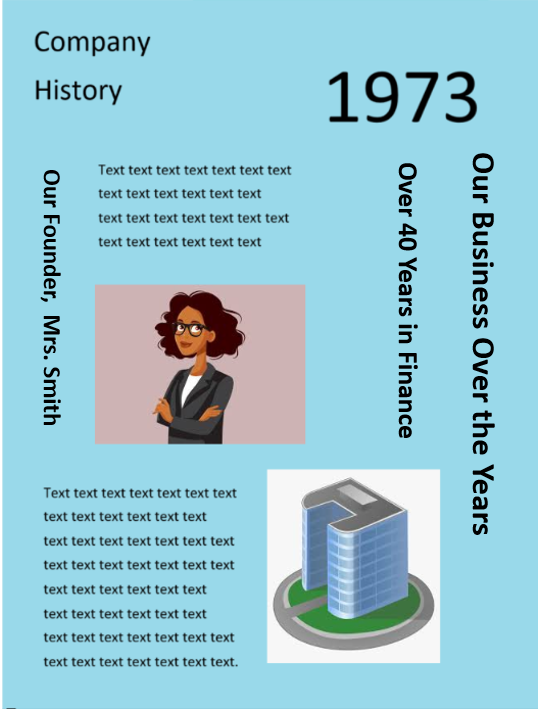
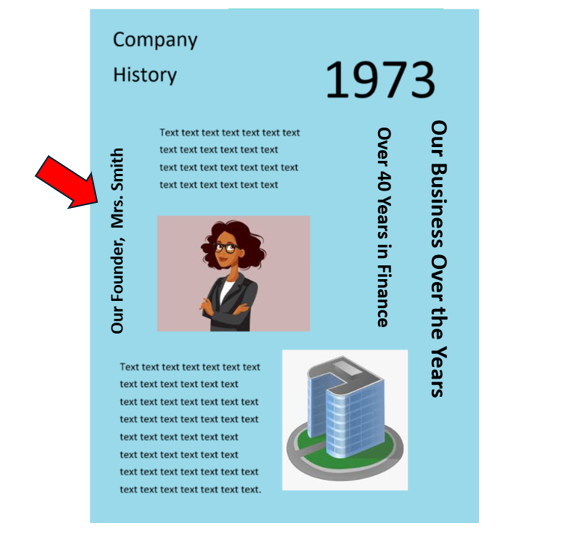
Take a look at this example page I created from a hypothetical integrated report.
Figure 1
With excessive use of vertical text like this, English readers are almost forced to break their next to read your report.
(True story: I once had to edit an 80-page integrated report full of vertical headings just like this. Imagine trying to read 80 pages like this!)
One study posted in the Journal of Vision found that reading speeds of vertical text drops significantly compared to horizontal text. (Journal of Vision)
While readers may be inclined to force their way through a spot or two of vertical text, an entire 80-page report is another story entirely. Readers may decide that reading such material just isn’t worth the hassle.
Your readers—global investors—expect reports that are easy to navigate. Vertical text can slow down their understanding, making them less confident in your materials.
When Vertical Text Can’t Be Avoided
There will, of course, be times when vertical text is unavoidable.
Oftentimes, when text reaches the translation stage, it’s too late to make any major changes to the design.
So what can you do? Let’s take a look at Figure 2.
Figure 2
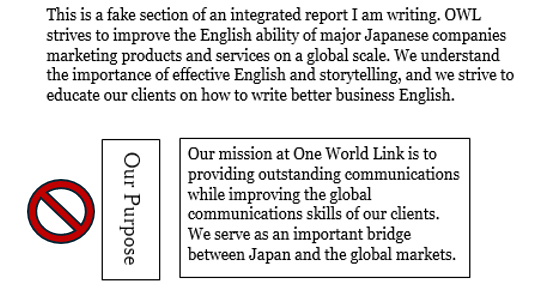
Notice how Our Purpose faces the outside of the page?
You may think this is the correct way to print vertical text in English, given that English text is read from top to bottom.
But as you may know, where there is a rule in English, there is almost always an exception.
If I underlined Our Purpose, that line would be facing the blank area, away from the text it should be heading. This makes it seem as if there is no relevant text under the title.
It’s best to rotate such text clockwise or counterclockwise to ensure that any unavoidable English text faces the relevant body text, even if it means not all titles face the same direction.
Let’s look back at Figure 1.
Figure 1 (Revised)
Even though the revised heading reads bottom to top and is different from the other headings, the heading now points to the correct information.
Tools like Adobe InDesign and Microsoft Word offer features to align vertical text more effectively. Use these to tweak layouts without redesigning from scratch.
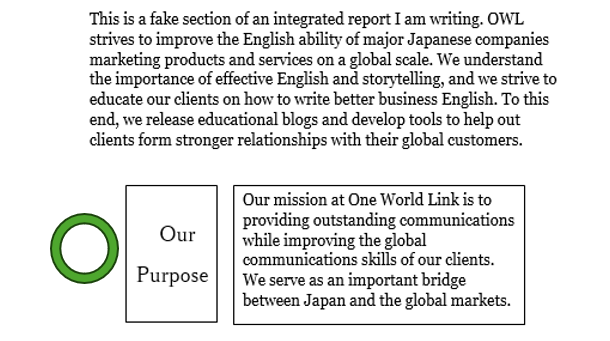
Another option you may have is widening the space allotted and using horizontal text, but this depends heavily on space.
Figure 2 (Revised)
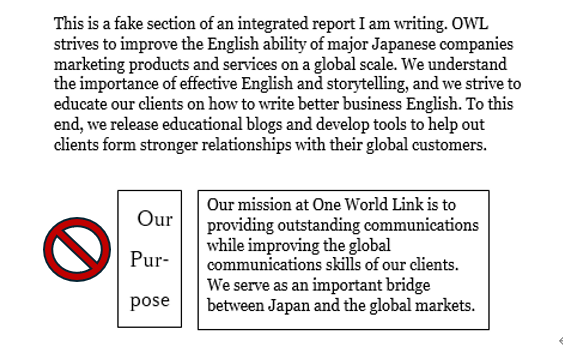
Only take this option if each word if you are able to do so without breaking up single words over multiple lines of text.
Figure 3
The Takeaway
Don’t lose readers to avoidable design flaws.
Remember: Your English-language report may be the first touchpoint global investors have with your company. If a label or title feels unclear, unnecessary, or awkward to read, readers may feel less inclined to continue reading and learn about your company.
Avoiding vertical text, or adjusting its orientation thoughtfully, isn’t just a design decision. It’s part of building trust. And for IR professionals, ensuring your reports meet global readability standards is essential. Take the time to audit your layouts and make small adjustments to vertical text where possible.
Before submitting your report, check for:
Vertical text that disrupts reading flow
Misaligned vertical headings
Alternatives like rotating titles to face the relevant body text
And if possible, collaborate with your design team early to ensure layouts accommodate both languages. A small conversation now can save significant headaches later.
In the world of investor relations and global communications, we sometimes become so focused on what we need to communicate that we forget to consider how best to convey our messages. Writing clear, professional English isn’t always about what you say, but how you present the information. The structures and format of your English text greatly affect how easily readers understand your message.
One technique professional business English writers use is to break information into clear, organized sections. For many overseas readers, long blocks of text can be tiring and difficult to follow. Whether you’re preparing an investor presentation, a shareholder letter, or a corporate report, dense paragraphs can cause readers to lose focus and miss key points.
To make your writing clear and engaging, try using bullet points and numbered lists. These tools help you present key information concisely and guide readers through your main ideas—an essential skill for anyone managing global corporate communications.
Why Bullet Points and Lists Work
Overseas audiences prefer concise communication.
Many English readers tend to skim through text, especially in business contexts where time is often limited. They want to find key information quickly and clearly.
Bullet points and numbered lists help transform dense information into a structured, easy-to-read format. These structures not only improve readability but also give your writing a more professional and polished look, making it easier to communicate complex ideas to overseas stakeholders.
Here are just a few benefits:
Visually appealing – Breaking up text with bullets or numbers creates breathing room on the page. It’s easier on the eyes.
Quick to read – Instead of forcing your audience to sift through a paragraph, bullets deliver the highlights instantly.
Easy to understand – Lists make it easy to organize complex ideas or multiple points in a way that’s simple to follow.
For non-native speakers, bullet points also simplify writing, reducing the chance of misinterpretation and ensuring the message is clear
Consider this example:
Our company adheres to multiple standards and recommendations, including the Task Force on Climate-related Financial Disclosures (TCFD) guidelines, the Global Reporting Initiative (GRI) standards, the United Nations Sustainable Development Goals (SDGs), the International Integrated Reporting Framework (IIRF), and the recommendations of the Sustainability Accounting Standards Board (SASB).
VS
Our company adheres to the following standards and recommendations:
Task Force on Climate-related Financial Disclosures (TCFD)
Global Reporting Initiative (GRI)
United Nations Sustainable Development Goals (SDGs)
International Integrated Reporting Framework (IIRF)
Sustainability Accounting Standards Board (SASB)
See the difference? This information just became way easier to digest with bullet points!
Buller Points or Numbered Lists?
Use bullet points when the order of items doesn’t matter. Research by Ho (2023) found that bullet points enhance the reading experience by helping readers absorb information more quickly and with less effort. For example:
Breaking down a long list into bite-sized information
Summarizing main ideas
Highlighting the most important information
Choose numbered lists when the sequence or ranking is important. They work well for:
Simply throwing the same long-winded, run-on sentences into bullet points won’t help clarify your message. The entire point of using bullet points and numbered lists is to break down your information into easily digestible bits of information. Too many, and the lists might seem daunting to readers.
Consistency is also key. Mixing verb and noun phrases is not standard in English. Use parallel structure in your bullet points and lists (e.g., if most points begin with a verb, make sure all other points do too). Be sure to also keep lists around the same length. As the article by Clearly Scientific states, “…switching from short text to long text is distracting, and may give a misleading impression of the importance of the entries.”
Ready to Transform Your Writing?
The next time you draft English corporate communications, remember that overseas readers value clarity and structure. Break up long paragraphs, use bullet points or numbered lists where appropriate, and make your messages easy to scan.
While these techniques may not apply in the same way to Japanese writing, they are highly effective in English business communication. Try applying them in your next IR report or stakeholder message.