One World Linkは約15年にわたり、日本企業の英文IRやコーポレートコミュニケーションを支援してきました。AIの進化によって変わったのは、「翻訳会社に頼むか、自社で翻訳するか」という選択肢だけではありません。いまは、それぞれの技術や専門家を、どの工程で使うかを設計することが、英文IR実務の重要なテーマになっています。
As your company begins drafting annual reports, take a moment to consider the final English translation.
You may think that planning for the translation stage is too early, especially if you haven’t yet drafted the original Japanese. However, this stage is the most effective time to think about translation.
Strong English output does not depend only on translation skills. A well-structured Japanese draft plays an equally important role. More logical Japanese leads to more logical English. Weak structure in your source text can appear in the English version, regardless of how skilled the translator is.
Let’s take a look at three core elements you should consider before you draft any investor relations materials: audience, objective, and outcome.
1. Audience
Identify your audience. Who will read your document?
Defining your primary reader allows you to shape the tone, terminology, and level of explanation in your report.
Primary readers include institutional investors, analysts, and overseas stakeholders, each with different expectations and levels of familiarity with your company. At the same time, your report may reach a broader audience, including global employees.
“If you’re not an investor, but an employee working within a corporation, the annual report can impart valuable information pertinent to your career. Understanding how your company is performing and the impact your actions have had on its business objectives can help you advocate for a promotion or other form of career advancement.”
Although this article addresses business school students and company employees, the takeaway here is that your audience might include more than those who are experts in finances, market analysis, and company valuation.
If you choose to write for a broader audience, focus on clear structure and accessible language. Avoid unnecessary complexity by limiting the use of lesser-known industry terms, overly complex financial language, internal terminology, and acronyms or abbreviations without context. Present information in a way that allows first-time readers to follow your narrative without needing to stress.
2. Objective
Clarify what your document needs to achieve.
The same Harvard Business School Online article explains that annual reports are unlike other pieces of financial data in that these reports are used as marketing collateral and include editorial elements and storytelling.
In other words, an annual report does not exist to present information alone. These reports should communicate financial performance, strategy, and a consistent narrative across all aspects of the business. But without a clear objective, the main message can become buried under information that does not guide the reader toward a single idea.
Clarifying your objective in each section of the report can help you avoid weighing down the Japanese with descriptions without purpose.
For example, if your company experienced a significant decrease in earnings, the financial review section may focus on explaining the key drivers behind that change, while the CEO message or individual business segment sections may reinforce how the company plans to increase earnings again.
Defining this intent in advance helps ensure that your narrative stays clear and consistent throughout the report.
3. Outcome
Define what you want your reader to think, understand, or do after reading.
Will your annual report shape how investors understand your growth drivers? Do you want analysts to model future performance with greater confidence? Or is your goal to build trust in your strategy and execution?
Ensure every section moves your reader toward this outcome. Section headers, titles, and word choice across the report should support the same direction.
A clear theme can help achieve this. See our blog on themes to understand why a strong theme can support your narrative and help ensure readers understand the takeaway.
The Takeaway
Define your audience, objective, and outcome before drafting. This step improves both your Japanese source text and your final English output. Strong investors relations communication depends on clarity of intent, not just language skills.
When you take time to structure your message before writing, you produce reports that investors can understand quickly and trust more easily.
例 English: In order to further strengthen our management foundation and realize sustainable growth over the medium to long term, we will continue to implement initiatives aimed at improving operational efficiency throughout the Group.
Rewrite: We will continue to improve operational efficiency across the Group to strengthen our management foundation and support medium- to long-term growth.
Why rewrite? ・「In order to」や「further」は語数を増やすだけで、意味の追加にはつながらない ・元の文は、主旨に至るまでに長い前置きと複数の説明が重なっている ・「implement initiatives aimed at improving」は表現が弱く、「improve」とすることでより直接的かつ簡潔になる
特に多く見られるのが「する」動詞の表現で、英語では conduct、implement、develop などの弱い動詞として表現されがちです。例えば、「conduct a share repurchase」や「implement a merger」といった表現は、多くの場合「repurchase shares」や「merge」とする方が、より簡潔で自然です。
もう一つの代表的なパターンが名詞化表現です。名詞化とは、動詞を名詞として表現することを指しますが、これにより文章が長くなり、分かりにくくなる傾向があります。例えば、「contribute to the enhancement of corporate value」は「(help) enhance corporate value」に、「conduct an evaluation of risks」は「evaluate risks」とすることで、より明確で簡潔な表現になります。
When preparing earnings materials, disclosures, or other investor communications in English, do you think about your global audience? Do you consider whether stakeholders from different countries and cultural backgrounds will be able to follow the logic and messaging clearly?
Your audience likely includes readers with different English proficiency levels, cultural backgrounds, and communication styles. Understanding how to write for a global audience can help make investor communications clearer, more accessible, and easier to understand across markets.
One approach that can help companies communicate more effectively with global audiences is Plain English.
In today’s blog, we will provide a more in-depth look at the Plain English approach, explore why tis method of writing was originally developed, and examine several rewrite examples that demonstrate how clearer writing can improve communication with global audiences.
The Plain English Approach
One World Link prioritizes using Plain English in our translations and we encourage companies to apply the same principles when communicating with global investors and stakeholders. But what exactly is Plain English?
In a recent blog on how effective IR communications are a competitive advantage, we briefly introduced Plain English as a writing approach that focuses on clear, accessible communication. The approach originally developed as a way to make government and legal documents easier for the public to understand.
This approach can be especially important when communicating with global audiences. English proficiency levels, cultural backgrounds, and communication styles can differ significantly across readers, making clarity and accessibility an important part of effective global communication.
Many of the principles associated with Plain English also overlap with the points we covered in our previous blog on Business English writing:
Write short, direct sentences
Use simple language and avoid idioms or slang
Make correct grammar and punctuation a priority
Be clear in your messages
Include strong vocabulary
Be careful when using industry-specific language or internal language
The following examples break down several Plain English rewrites based on these Business English writing principles and demonstrate how small adjustments can make corporate communications clearer and easier for global audiences to understand.
Write short and direct sentences
Japanese sentences often contain multiple clauses and background explanations. Direct translations can therefore become long and difficult to read.
Ex.
English: In order to further strengthen our management foundation and realize sustainable growth over the medium to long term, we will continue to implement initiatives aimed at improving operational efficiency throughout the Group.
Rewrite: We will continue to improve operational efficiency across the Group to strengthen our management foundation and support medium- to long-term growth.
Why rewrite?
“In order to” and “further” add words, but do not add meaning.
The original sentence contains a long introductory clause and several layers of explanation before reaching the main point.
The phrase “implement initiatives aimed at improving” is weak. Changing to “improve” is more direct and concise.
Use simple language; avoid idioms or slang
Idioms depend on cultural familiarity. Global readers who speak English as a second language may not immediately understand the meaning.
Ex.
English: Our new strategy is a game-changer for the company.
Rewrite: Our new strategy will completely transform our [XYZ].
Why rewrite?
The phrase “game changer” is an idiom that some global investors might not understand. Using simpler phrasing that keeps the same impact helps ensure understanding for all readers.
Use correct grammar and punctuation
Though a bit obvious, grammar and punctuation should be a priority, instead of bending English rules to match the Japanese structure.
For example, English only uses quotation marks in limited situations. Quotation marks are not a simple translation for every use of Japanese brackets.
Ex.
English: The company implements initiatives under the concept of “value creation.”
Rewrite: The company implements initiatives focused on value creation.
Why rewrite?
We use quotation marks for direct quotes, titles, unusual terminology, and even sarcasm in English. We never use quotation marks to emphasize a word or a phrase.
Ensure clarity
Japanese writing, in particular, tends to omit subjects and use passive language frequently. These habits, while perhaps acceptable for Japanese readers, negatively impact readability and clarity in English.”
Ex.
English: The results of deliberations are reported to the Executive Committee and incorporated into the company strategy.
Rewrite: The Board of Directors reports deliberation results to the Executive Committee, which translates results into the company strategy.
Why rewrite?
The original uses passive voice, which hides who performs what actions. Clarity is key in governance reporting. Be sure to use subjects and keep sentences simple to ensure clarity.
Using strong vocabulary
Japanese writing often relies on verb-noun structures, which AI and machine translation tend to render as indirect, verb-heavy phrases in English.
Some of the most common examples come from する verbs, which often appear as weak verb constructions in English, such as conduct, implement, and develop. Phrases like “conduct a share repurchase” or “implement a merger” can be written more concisely and naturally as “repurchase shares” or “merge” in most contexts.
Another common pattern is the use of nominalizations. Nominalizations, or verbs expressed as nouns, often create long and wordy phrases that reduce clarity. For example, “contribute to the enhancement of corporate value” can be simplified to “(help) enhance corporate value,” and “conduct an evaluation of risks” can be rewritten as “evaluate risks.”
Direct translations of verbs such as realize, promote, and strengthen can also sound vague or unnatural, as their usage differs from typical English contexts.
A plain English approach favors using a single, strong verb to keep sentences clear and concise.
Ex.
English: The company will contribute to the realization of a sustainable society.
Rewrite: The company will help build a sustainable society.
Why rewrite?
“Contribute to” is a weak verb that does not explain the company’s action.
“Realization of” is problematic on a few levels.
First, we want to avoid nominalizations when possible.
Word choice. Realization is not natural in this context.
Another area in which OWL recommends using strong verbs is in place of adverbs and weak verbs. Business Japanese relies on many adverbs that we can remove and rewrite into stronger verbs.
Ex.
English: We will further strengthen efforts to expand overseas operations.
Rewrite: We will strengthen efforts to expand overseas operations.
Why rewrite?
Words such as expand, strengthen, improve, increase, enhance, and develop already imply movement or progress. Adding “further” often repeats the same idea without adding meaningful information.
Conclusion
Ensuring your message is clear to people across the world is the number one way to write for a global audience. Simplicity is key.
Contact OWL and let us help you tell your story to the world.
Ex. 1 Original: Company Name Co., Ltd. (Securities code: 0000; the “Company”) hereby announces that XXX Co., Ltd. has resolved, at its meeting of the Board of Directors held on MM DD, YYYY, to acquire the shares of the Company through tender offer as described in the attachment.
こちらは、株式公開買付けに関する開示において、JPXのテンプレートをもとに英訳された例です。
ご覧のとおり、情報が一文に詰め込まれており、読みにくい構造になっています。
文の構造を整理し、語句を少し調整することで、より明確で読みやすい文章にすることができます。
Rewrite: Company Name Co., Ltd. (Securities code: 0000; the “Company”) announced that the XXX Co., Ltd. Board of Directors approved a resolution to acquire shares of the Company via tender offer, as described in the attached materials. The meeting in question was held on MM DD, YYYY.
もう一つの例を見ていきます。
Ex. 2 Original: Although the electronic component business saw lower average selling prices resulting from inventory adjustments by customers in the previous fiscal year, demand grew for high value-added power management ICs for semiconductor applications, mainly in Europe, and operating efficiency improved due to cost reduction efforts, resulting in higher sales.
こちらは、One World Linkで日常的に見られる、日本語から英語への直訳に近い構造の例です。文全体の結論である「売上が増加した」というポイントが、長い説明の後ろに埋もれている点に注目してください。
Revised: Sales increased in the electronic component business. despite lower average selling prices in the previous fiscal year due to customer inventory adjustments. This result reflects strong demand for high-value-added power management ICs for semiconductors in Europe and stronger operating efficiency driven by cost reductions.
また、「resulting from inventory adjustments by customers」は「due to customer inventory adjustments」に、「cost reduction efforts」は「cost reductions」に置き換えています。複雑な表現を、より簡潔で力のある語に変えることで、可読性が向上します。
Ex. 1およびEx. 2では長い文を扱いましたが、短い文であっても同様に改善は重要です。
次の例では、短い文の明確さをどのように高めるかを確認します。
Ex. 3 Original: We are working to contribute to the promotion of sustainability through our business activities.
Revised: We support sustainability through our business activities.
このような表現は、日本語から英語への翻訳で非常によく見られます。「working to contribute to」や「the promotion of」は、「貢献」「推進」といった日本語表現をそのまま反映したものです。
Ex. 4 Original: Our Group is promoting initiatives such as reducing environmental impact and contributing to local communities in order to realize a sustainable society.
Revised: The Group supports a sustainable society by reducing environmental impact and contributing to local communities.
“in order to” 「in order to」は直訳で多用されますが、多くの場合「to」で十分に意味が伝わります。簡潔な表現の方が可読性が高くなります。
Ex. 5 Original: Net sales increased significantly by 28.5% year on year as a result of the expansion of sales in overseas markets and the strengthening of product competitiveness.
Revised: Net sales rose 28.5% year on year, driven by higher overseas sales and stronger product competitiveness.
多くの米国企業は、開示文書の明確性を高めるため、「Plain English」を用いて財務情報を開示しています。その際、米国証券取引委員会(SEC)が公表した『Plain English Handbook 2011』を参照しています。SECは、投資家が重要な情報を不必要な複雑さなしに理解できるよう、短い文章、能動態、具体的な表現、論理的な構成の使用を推奨しています。
I’m sure you’ve heard the term “business English” many times in your career. From finance and government to multinational corporations, business English appears across a wide range of formal workplace settings.
Emails, proposals, reports, presentations, and meeting materials are just a few media you might associate the term with. But what actually makes business English “business”?
Let’s look at how established institutions define business English, what characteristics distinguish it from general English, and how those principles apply in practice. Then, let’s consider why audience awareness is especially important when communicating with your company’s stakeholders.
Definition
Indeed, a global employment platform, published a career development article that defines business English as “a type of writing that focuses on clearer, more direct language without slang, idioms, or grammatical errors.”(Indeed Career Guide)
The article further dives into how business English carries stricter expectations for vocabulary, grammar, and sentence structure, explaining, “Clarity and consistency are important components of business English, which is why it focuses so heavily on things like strong vocabulary and well-written sentences.” (Indeed Career Guide)
Pearson, a multinational education company known for publishing textbooks, academic materials, and various types of other English language training content, also frames business English in a similar way, stating:
“Business writing refers to the clear and purposeful use of language in written form within a professional context. It encompasses a wide range of documents, including emails, reports, proposals and presentations, tailored to communicate effectively with clients, colleagues and stakeholders.”
Across these definitions, several themes emerge consistently: clarity, correctness, structure, and purpose.
Core Attributes of Business English
Based on these definitions, business English rests on a few core pillars:
Clarity
Correctness
Direct language
Consistency
But how can you communicate with these attributes in mind?
The Indeed article outlines several practical things to keep in mind when writing business English communications:
Write short, direct sentences
Use simple language and avoid idioms or slang
Make correct grammar and punctuation a priority
Be clear in your messages
Include strong vocabulary
In contrast, Japanese corporate writing is rooted in cultural communication norms that can prioritize context building, careful explanation, and layered messaging before presenting conclusions.
This approach can be the antithesis of many Business English writing practices and requires translators to exercise care when translating Japanese content into English.
Let’s take a look at how business English practices are applied. Consider the following example from a typical earnings report.
Ex. 1
Original: Company Name Co., Ltd. (Securities code: 0000; the “Company”) hereby announces that XXX Co., Ltd. has resolved, at its meeting of the Board of Directors held on MM DD, YYYY, to acquire the shares of the Company through tender offer as described in the attachment.
This is an example of an English translation from a JPX disclosure template on a notice concerning a tender offer of shares.
As you can see, the sentence is overloaded with information and is hard to read.
We can make this a bit easier to read by restructuring the sentence and making small edits to word choice to improve clarity.
Rewrite: Company Name Co., Ltd. (Securities code: 0000; the “Company”) announced that the XXX Co., Ltd. Board of Directors approved a resolution to acquire shares of the Company via tender offer, as described in the attached materials. The meeting in question was held on MM DD, YYYY.
Here’s another example.
Ex. 2
Original: Although the electronic component business saw lower average selling prices resulting from inventory adjustments by customers in the previous fiscal year, demand grew for high-value-added power management ICs for semiconductor applications, mainly in Europe, and operating efficiency improved due to cost reduction efforts, resulting in higher sales.
This sentence is an example of the type of structures and wording we come across quite often in direct Japanese-to-English translation at One World Link. Notice how the overall outcome (“sales increased”) doesn’t appear until the end of the sentence, buried beneath a lengthy explanation.
While this style of writing is more typical in Japanese, it creates run-on sentences and muddles the intent to report on the results.
How can we make this information clearer to readers? Let’s take a look at how writers at OWL might rewrite this sentence into business English.
Revised: Sales increased in the electronic component business. despite lower average selling prices in the previous fiscal year due to customer inventory adjustments. This result reflects strong demand for high-value-added power management ICs for semiconductors in Europe and stronger operating efficiency driven by cost reductions.
Again, the first thing we would do is bring the result to the forefront of the sentence.
We would then rework the “why” and the “how” to support this result. The original example is overloaded, cramming both positive and negative factors into the same sentence. Our revision breaks down this sentence into two clearer, more direct pieces of information.
Notice also how “resulting from inventory adjustments by customers” becomes “due to customer inventory adjustments,” and “cost reduction efforts” becomes “cost reductions.” Rewriting overly complicated structures to stronger and more direct verbs is a great way to enhance readability.
It’s important to note that while Ex. 1 and Ex. 2 deal with long sentences, making adjustments to smaller sentences is still equally important in business English.
Let’s take a look at the next two examples to see how we can improve clarity in shorter sentences.
Ex. 3
Original: We are working to contribute to the promotion of sustainability through our business activities.
Revised: We support sustainability through our business activities.
This example is highly common in Japanese-to-English translation. Weak phrases like “working to contribute to” and “the promotion of,” which mirror Japanese expressions such as 貢献 and 推進. While the original sentence is grammatically correct, the structure is incredibly confusing and unnecessarily long. Remember, business English prefers clear, direct sentence structures with strong vocabulary. “We support” expresses the same idea in a way that aligns with business English writing conventions.
Another noteworthy change involves the verb form. Literal translations often use -ing constructions because Japanese frequently uses progressive expressions like 取り組んでいます or 推進しています. In English business writing, however, the simple present tense is usually stronger and clearer.
Ex. 4
Original: Our Group is promoting initiatives such as reducing environmental impact and contributing to local communities in order to realize a sustainable society.
Revised: The Group supports a sustainable society by reducing environmental impact and contributing to local communities.
This is an example of a typical AI translation of Japanese that we might come across. As we discussed above, the revision changes the verb form to simple present tense and moves the main idea forward. The revision also addresses a few issues that make the original writing sound like a direct translation.
1. “Our Group”
“Our Group” is technically incorrect. We capitalize Group only when it replaces the company’s proper name. In this sentence, “group” is a general noun, so lowercase is correct. If you want to reflect 当社グループ in English disclosure writing, “The Group” is the appropriate expression.
2. “is promoting initiatives”
“Promoting” is a direct translation of 推進. In English business writing, however, companies do not usually “promote initiatives.” The verb sounds unnatural in this context and does not clearly describe the action. Stronger alternatives include pursue, implement, or carry out, depending on the meaning of the original sentence.
3. “in order to”
“In order to” is often used in literal translations of Japanese text. In most cases, “to” communicates the same meaning more clearly and concisely. Shorter phrasing improves readability and aligns with common Business English writing practices.
Ex. 5
Original: Net sales increased significantly by 28.5% year on year as a result of the expansion of sales in overseas markets and the strengthening of product competitiveness.
Revised: Net sales rose 28.5% year on year, driven by higher overseas sales and stronger product competitiveness.
This sentence is something we might see in a quarterly earnings report.
Like Ex. 3, the original translation here is much simpler than Ex. 1 and Ex. 2. Being short, however, doesn’t automatically mean the sentence is direct or clear. There are still areas in which we can use stronger, more concise vocabulary.
Japanese writing often relies on verb-noun structures, which AI and machine translation tend to render as indirect, verb-heavy phrases in English. Some phrases appearing often in Japanese to English translation include sentences ending in 〜の実施, 〜の強化, or 〜の推進. AI and machine translation often render these phrases as nominalizations like “the implementation of,” “the strengthening of,” or “the advancement of.”
Such phrases and nominalization weigh down the sentence and impact readability. Replacing “the expansion of sales in overseas markets” with “higher overseas sales” results in a more concise and direct message.
Business English in the Financial Sector
Business English applies across industries, but tailoring your writing to your audience is essential.
Investor relations communications differ from general corporate writing, given that primary readers operate in financial markets. Institutional investors, analysts, and global shareholders review disclosures under time constraints. Many compare performance across multiple companies, industries, and jurisdictions in a single day. Instead of looking for emotional persuasion, they expect clear and accurate results, logical explanations, and consistent terminology.
Many U.S. corporations file their financial disclosures using Plain English to improve the clarity of disclosure documents, referencing the Securities and Exchange Commission’s Plain English Handbook 2011. The SEC encourages companies to use short sentences, active voice, concrete terms, and logical organization so investors can understand material information without unnecessary complexity.
Practice Makes Perfect
Writing business English is a major skill that takes time and practice to develop.
You can enhance your skills by reviewing examples, analyzing sentence structure, identifying weak verbs and nominalizations, and consistently asking one question: Does this sentence communicate the result clearly to the intended reader?
For more practice, follow One World Link on Facebook or LinkedIn, where we regularly share business English writing tips, examples, and short quizzes designed for professionals in corporate and financial communications.
A Caution When Using AI and Machine Translation
AI translation systems learn from large datasets of aligned sentence pairs, meaning these systems often mirror the structure of the Japanese source sentence instead of restructuring the input for natural English. As a result, the English output frequently retains Japanese writing patterns. Long sentences remain long, context appears before the main point, and conclusions often appear at the end.
If you rely on AI translation for Japanese reports, always check whether the English follows natural English writing conventions. You may need to implement the methods we discussed in this blog to shorten sentences, move key points earlier, or simplify explanations so overseas readers can quickly understand your message.
プレインイングリッシュは、明確さと分かりやすさを重視した考え方であり、グローバルな読者に向けて情報を発信する企業に適したライティング手法です。このライティング手法は、もともと政府文書や法律文書を一般の人々にとって理解しやすくするために生まれました。One World Linkでは、企業が同じ考え方を取り入れることで、海外投資家やステークホルダーに対して、より明確かつ効果的に情報を伝えられるようになると考えています。
In our previous blog, we discussed a resurfaced video in which Peter Thiel, chair of Palantir Technologies, briefly discussed the level of impact the expansion of AI may have on people in math-related fields versus those in more writing-based fields.
We dived into a Wall Street Journal article that then discussed the rise in corporations searching to communicate more through “storytelling.”
Today, let’s take that discussion one step further and talk about why effective storytelling in investor relations can become a competitive advantage.
Why Narrative Matters in IR
Investors do not evaluate companies based on numbers alone.
Sure, financial metrics are essential, but investors also need to understand the strategy behind those numbers.
Studies show that investor relations communication and more frequent engagement can improve company valuation, liquidity, and institutional ownership. (*IDEAS / RePEc journal article)
In other words, a good narrative can influence how the market perceives a company.
This narrative is often called a company’s equity story and connects several key elements:
Business strategy
Competitive positioning
Growth opportunities
Capital allocation decisions
Long-term value creation
Let’s take a look at a report by Corbin Advisors titled Maximizing Valuation Through Strategic Investor Communication. Corbin Advisors is a U.S. company that provides strategic advisory services in investor relations and communications, supporting publicly traded companies in building sustainable shareholder value. In this article, the company highlights how important effective communication has become in modern capital markets.
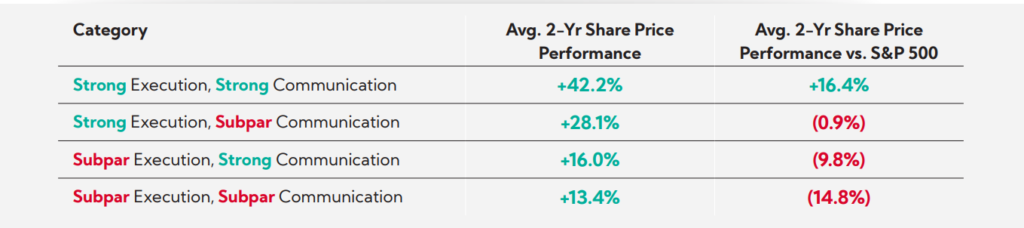
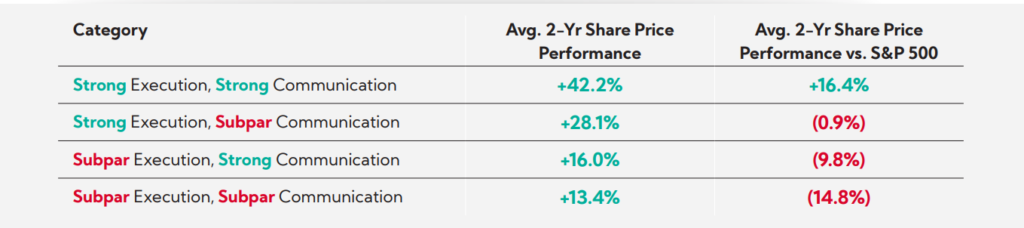
Based on more than 24,000 interviews with the investment community, the research by Corbin Advisors suggests that roughly 40% of a company’s valuation can be influenced by investor relations and communication, either positively or negatively. The same study also found that companies perceived to combine strong execution with strong communication significantly outperform peers in share price appreciation. (Corbin Advisors PDF)
Corbin Advisors, Maximizing Valuation Through Strategic Investor Communication, 2025
In a market where investors follow dozens of companies at once and face an overwhelming amount of information, a clear and compelling investment story can play a major role in capturing investor attention and building long-term confidence. If you are interested in learning more, the full report is worth reading here.
The Growing Use of AI in Corporate Communication
In recent years, an increasing number of companies are looking to AI to cut costs and increase efficiency. In the world of investor relations, this shift can look like reducing personnel and internalizing translation by relying on AI tools or generative translation instead of outsourcing work to professional translators or communications specialists.
But relying on AI tools and generative translation in corporate writing runs the risk of companies losing their narrative and originality in repetitive, second-hand output.
At first glance, relying on AI and cutting personnel may seem efficient. AI tools can quickly generate English text from Japanese source material. They can summarize information and produce draft translations in seconds. However, there is a risk that companies relying heavily on AI may gradually lose their original voice and narrative.
When many organizations use similar tools and prompts, the output often becomes repetitive. Over time, corporate messaging can begin to sound standardized, generic, and indistinguishable from competitors.
The Hurdle of Japanese-to-English
Japanese and English are extremely different languages to translate between. From sentence structure to word choice, and even the tone of business materials, writing clear and effective communication takes more than direct translation.
Japanese business writing tends to rely on long sentences, indirect structure, and implied subjects. English investor communications, on the other hand, typically prefer result-first structures, clear subjects, and active voice.
Using large language models to translate often produces English that mirrors Japanese sentence structures. The translation may be technically correct, but the output frequently reads like a direct, one-to-one translation.
This type of English can be difficult for international investors to read. Following the Japanese structure too closely can make your message too hard to understand, resulting in less effective communication.
Another factor worth considering is the growing number of frameworks and guidelines used in sustainability and ESG reporting. Standards from organizations such as the ISSB, GRI, and TCFD often encourage companies to disclose similar types of information using similar terminology. As a result, sustainability sections in many reports can begin to sound almost identical once translated into English.
Following these guidelines is essential. However, you still have flexibility in how you communicate your message.
Clear and concise writing can often convey the same information in fewer words while highlighting your unique strategy and strengths. Communicating the same required disclosures more clearly and effectively than other companies can create an opportunity to differentiate your company in the eyes of global investors.
Differentiation Through Communication
Modern investors face an overwhelming amount of information, with institutional investors often following dozens of companies at the same time.
Companies that communicate clearly and consistently can stand out more easily in this environment.
Strong investor communication helps companies in the following areas:
Build trust with investors
Explain complex strategies clearly
Differentiate themselves from competitors
Attract long-term shareholders
Companies that invest in strong storytelling can therefore gain an advantage over companies that rely on generic communication.
The Plain English Approach
One practical way to improve IR communication is by adopting Plain English.
Plain English focuses on clarity and accessibility, making it a strong choice for companies communicating with a global audience. This writing approach began as a way to make government and legal documents easier for the public to understand. One World Link encourages companies to apply the same approach to communicate more clearly and effectively with global investors and stakeholders.
Check out our previous blogs on Plain English here. Make sure to stay tuned for upcoming posts where we take a deeper look at what Plain English is and how to apply this approach in practice.
In Summary
An increasing number of companies are looking to AI and generative translation tools for translation. But effective investor relations is not simply about speed and quantity—it’s about the quality of your message and differentiating your narrative from your competitors.
Companies that invest in effective communication and professional writing can strengthen investor understanding, build trust, and differentiate themselves in global capital markets.
実際、Wall Street Journalによると、LinkedIn上の求人において「storyteller」や「storytelling」といった語を含む掲載数は、過去1年間(2024年11月27日〜2025年11月26日)で倍増しました。記事掲載時点では、マーケティング関連の求人が約50,000件、メディアおよびコミュニケーション関連が約20,000件に達しています。
1. YouTube video Mercatus Center. (2024, April 17). Peter Thiel on political theology | Conversations with Tyler [Video]. YouTube. https://www.youtube.com/watch?v=vfbndRTlsg4