
7 Benefits of Publishing in HTML

(日本語ブログ:HTMLで統合報告書を発信する7つのメリット|One World Link

Do you publish your integrated reports as a PDF to download? If you’re not printing your material, you might be missing a chance to interact with stakeholders more effectively.

PDFs have long been used and offer countless benefits to publishing and printing material. But corporate communications are evolving. As more companies switch to paperless communication, it turns out that PDFs are no longer the best option.

How do you know your reports are being read? Do you track PDF downloads? Understanding these analytics is key to understanding your stakeholders and what they value most.

Companies like Microsoft, Philips, BASF, and Bayer publish comprehensive online reports that use hyperlinks to enhance content connectivity and user navigation.

Using HTML can help you not only offer easier access to readers but also understand your audience better through analytics.

HTML vs PDF

According to the Corporate Value Reporting Lab, the number of Japanese corporations publishing integrated reports has been on the rise. More than 1,000 Japanese companies published integrated reports in 2023, up from just over 200 in 2015, with the number of issuing companies expected to rise. (For more detailed information, see the Full Report.)

While there isn’t any readily available data on the number of companies that publish using PDF vs HTML, the trend toward digital reporting is evident.

Dr. Eloy Barrantes, Chief Executive Officer of Nexxar, commented in a 2018 news article on the IFRS Foundation Integrated Reporting website, “Although integrated online reports have become well-established in many companies, they are often neglected when it comes to conception and design. Good HTML reports consider media-specific requirements of the web as a publication channel.”

He continued to add, “Today’s best-practice examples of online reports are often from companies that have been publishing HTML reports for many years and attach importance to it in both their publication and communication strategies.”

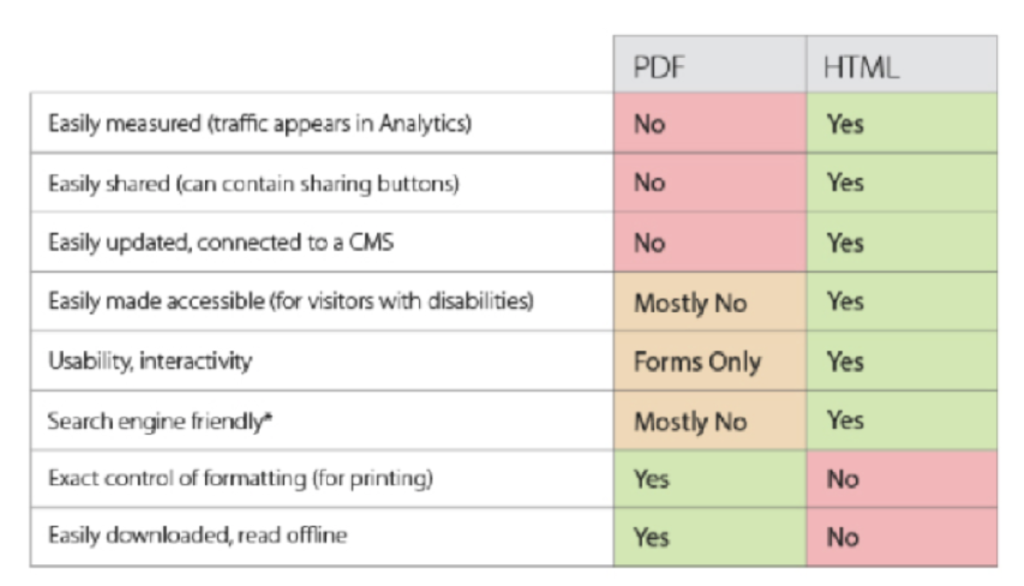
For IR professionals, publishing reports in HTML can enhance readability, accessibility, and engagement, ensuring overseas stakeholders easily grasp key points. It also improves search engine visibility, helping more investors find your reports online. You might be asking yourself, “How exactly do PDFs and HTML differ?” Let’s take a look at the general differences in this chart.

Figure Source: (Content Marketing Institute)

Notice that HTML offers everything except the exact control for printing and the option to download for offline use. The advantages of using a PDF are centered around printing published material.

Now, let’s take a more in-depth look at some of the benefits of HTML.

  1. Improved Accessibility
    HTML is far more accessible for users with disabilities. Assistive technologies like screen readers can easily interpret HTML, making your content available to everyone.
  1. Mobile-Friendly Experience
    Have you ever pinched and zoomed endlessly to read a PDF on your phone? HTML solves this. Its responsive design adjusts to any screen size, ensuring a seamless reading experience.
  1. SEO Benefits
    HTML content gets indexed by search engines, improving discoverability. PDFs, on the other hand, are less SEO-friendly and rarely optimized for search.
  1. Interactive Features
    HTML supports hyperlinks, videos, animations, and interactive data visualizations. This keeps readers engaged and makes your content more dynamic.
  1. Faster Loading and Performance
    No one likes waiting for a massive PDF to load. HTML is lighter and faster, especially for larger documents.
  1. Real-Time Updates
    Made a mistake? Need to add new information? With HTML, updates are instant. There’s no need for users to re-download anything.
  1. Analytics and Tracking
    Want to know which sections your readers find most interesting? HTML lets you track user behavior, giving you insights that PDFs can’t provide.

Switching to HTML doesn’t just improve readability—it also saves time. You can update content instantly without needing to re-download files. This means fewer errors, faster revisions, and less stress when working under tight deadlines.

Why Stick with PDFs?

If your goal is digital-only distribution, there’s no reason to cling to outdated PDFs. Save them for printable materials—but choose HTML for a more user-friendly, modern approach.

Not ready for a full transition? Start small—convert your key figures into HTML and compare reader engagement metrics. Many companies even offer a hybrid of both HTML and PDF. Check out the 2023 Bayer Annual Report for an idea of how this would look.

In Short

The digital landscape is evolving fast. Don’t let outdated formats slow you down. Using HTML aligns with global best practices, showing overseas investors that your company values innovation and accessibility. Adopting HTML-based integrated reporting allows organizations to not only future-proof communication strategies but also stand out as leaders in transparency and innovation. If your company is new to this concept, understand that embracing HTML reporting is not just a technological upgrade—it’s an opportunity to tell your story in a way that resonates with modern, digitally-savvy stakeholders.

For an idea of what HTML reports (and hybrid examples) look like, check out any of the following websites.

https://report.basf.com/2023/en

https://www.clariant.com/en/Company/Integrated-Report/Integrated-Report-2023

https://www.results.philips.com/publications/ar23

https://www.microsoft.com/investor/reports/ar23/index.html

https://www.intc.com/news-events/press-releases/detail/1716/intel-reports-third-quarter-2024-financial-results

https://www.bayer.com/en/investors/integrated-annual-reports

The Tiny Mark That Sparks Big Debates

(日本語ブログ:小さなカンマが大きな議論に!オックスフォード・カンマは必要?|One World Link

What is the Oxford Comma?

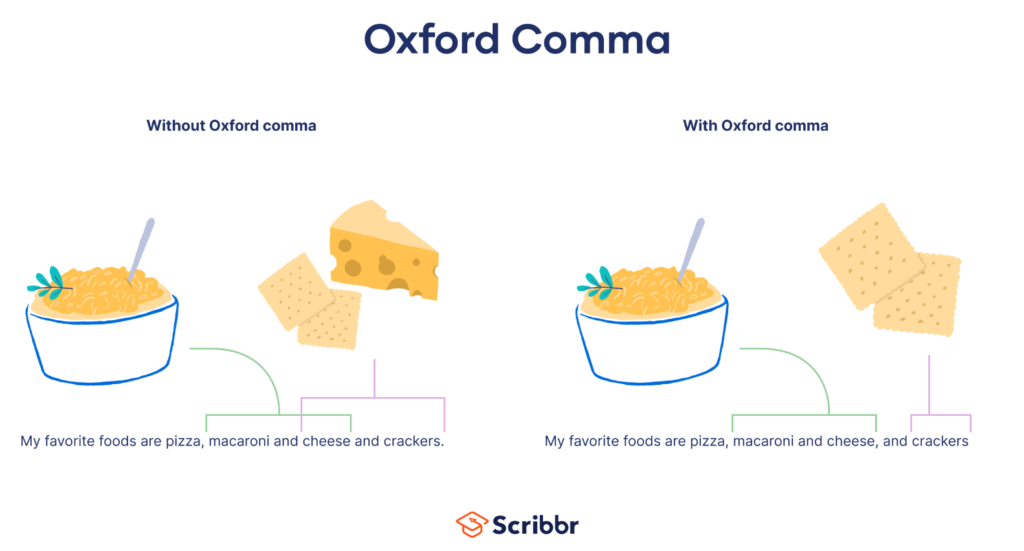
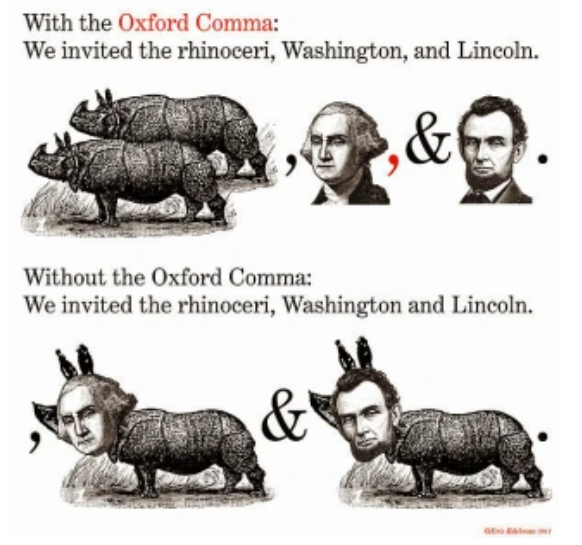
The Oxford comma, also known as the serial comma, is one of the most debated punctuation marks in the English language. It appears before the final item in a list, just before the conjunction (usually “and” or “or”).

  • (Ex.) I bought apples, oranges, and bananas.

In this sentence, the Oxford comma comes after “oranges.”

Some critics argue this comma is often unnecessary and clutters writing, especially when the meaning is already clear.

Why Is the Oxford Comma Important?

While this comma may seem like a minor detail, the presence (or absence) of this tiny mark can dramatically alter the meaning of a sentence. Without it, readers might misinterpret the sentence—especially when the items in the list are complex or could logically be grouped together.

Ex. 1

Ex.2

Ex.3

Without Oxford comma: “The report was prepared by the marketing department, John and Sarah.”
-This suggests that John and Sarah are part of the marketing department.

With Oxford comma: “The report was prepared by the marketing department, John, and Sarah.”
-This version clarifies that John and Sarah are separate contributors.

Consistency Is Key

Ultimately, the Oxford comma is a matter of style preference. The use of this comma is standard in American English and is often used in formal writing to avoid ambiguity. However, this comma is less common in British English and is typically reserved for cases where clarity is needed. Whether you choose to use the Oxford comma or not, it is important to remain consistent throughout your entire document.

At OWL, we recommend using the Oxford comma.

If you’re unsure whether to use the Oxford comma, consider these factors:

  • Clarity: Does omitting the comma make the sentence unclear or open to multiple interpretations?
  • Consistency: Are you writing in a style guide that requires (or forbids) the Oxford comma? For example, the Chicago Manual of Style recommends it, while the Associated Press (AP) style does not.

Note: OWL values clarity and brevity in communicating your story to diverse stakeholders. For this reason, we use the Oxford comma, even though we follow the AP Stylebook.

May 2025 Quiz Answers

(水) 5月07日

Q. ビジネス英語における、1文の理想的な平均語数はどれくらいでしょうか?
a. 15 words
b. 20 words
c. 30 words

正解:b.
解説:
ビジネス英語では、1文あたりの語数は約20語が目安とされています。内容を明確に伝えるため、40語を超える長文は避けた方がよいとされています。短く、わかりやすい文を意識しましょう。

    新たな製品やサービスの開発を通して、クライアント様のお役に立ちたいと考えております。
    お手数をお掛けしますが、簡単なアンケートにご協力をお願いいたします。

    英文ビジネスライティングの学習経験はございますか?

    学習された期間は何年間ですか?

    英文ビジネスライティングをさらに学びたいと思いますか?

    (月) 5月12日

    Q.次のうち、ビジネス英語として最も簡潔で自然な表現を選んでください。
    a. We conducted a hearing for the purpose of understanding stakeholder opinions.
    b. We held a hearing to understand stakeholder opinions
    c. We did a hearing for understanding stakeholder opinions.

    正解:b.
    解説:
    「Held a hearing to understand(〜するためにヒアリングを実施した)」は、簡潔かつ自然な表現です。
    aの「for the purpose of understanding(〜する目的で)」は文法的には正しいですが、冗長に感じられます。”to understand” に短縮することで読みやすくなります。
    cは “did a hearing” という不自然な表現を使っており、ビジネス文書には不適切です。

    (水) 5月14日

    Q.過度に形式的な次の英文を、最も適切なビジネス英語に修正したものを選んでください。
    We hereby announce the completion of the acquisition.
    a. We have completed the acquisition.
    b. The acquisition has been completed.
    c. We hereby inform you of the acquisition completion.

    正解:a.
    解説:
    「We have completed the acquisition(買収を完了しました)」は、現代のビジネス英語で好まれる、明確で直接的な表現です。
    bは受動態で、場合によっては使えますが、ビジネス英語では能動態の方が読みやすく自然に感じられます。
    cは “hereby” や “inform you of” などの硬い表現が並んでおり、現代の英語としてはやや古めかしく感じられます。

    (金) 5月16日

    Q. 次の日本語を、最も適切なビジネス英語に翻訳したものを選んでください。

    「コスト削減策を講じました。」

    a. We reduced costs.
    b. Cost-reduction measures were implemented.
    c. We took cost-reduction measures.

    正解:c.
    解説:
    「We took cost-reduction measures(コスト削減策を講じました)」は、自然でよく使われるビジネス英語の表現です。
    aは意味が近いですが、単に結果(コストを削減した)に焦点を当てており、「施策を講じた」というニュアンスが抜けています。
    bは受動態になっており、英語のビジネス文書では推奨される“能動態を90%以上使用する”という原則からは外れます。

    (水) 5月21日

    Q.次の英文の続きとして最も適切なものを選んでください。
    The board of directors consists of seven members who make positive contributions to board discussions.
    a. The board meets once a month to
    b. They meet once a month to…
    c. It meets once a month to…

    正解:a.
    解説:
    aのように、主語を繰り返して明示する方がビジネス文書では明確で好まれます。
    bの “They” は直前の “discussions” を指しているようにも読めるため、文意が曖昧になります。
    cの “It” は technically に “the board” を指していますが、ビジネス英語では “It” で文を始めると曖昧・抽象的な印象になりやすく、避けた方が無難です。

    (金) 5月23日

    Q. 次の文のような “the fact that” という表現は、ビジネス英語として明確でプロフェッショナルでしょうか? 
    We revised our forecasts upwards in light of the fact that demand recovered faster than expected.
    a. はい
    b. いいえ

    正解:b. いいえ
    解説:
    “in light of the fact that” は冗長な表現で、ビジネス英語では簡潔さが重視されるため避けた方が良いとされています。以下のように書き換えることで、より洗練された印象になります:

    • We revised our forecasts upwards due to stronger-than-expected demand.
    • We revised our forecasts upwards as demand recovered faster than expected.
    • We revised our forecasts upwards following a faster-than-expected recovery in demand.

    このように短く言い換えることで、同じ意味をより自然かつ明快に伝えることができます。

    (水) 5月28日

    Q. 次の日本語に対する英訳として、ビジネス英語で最も適切なものを選んでください。

    「社外取締役が経営陣に助言を行います。」

    a. Advice is provided to management by outside directors.
    b. Outside directors provide advice to management.
    c. Management is advised by outside directors.

    正解:b.
    解説:
    選択肢bは能動態で書かれており、英語のビジネス文書では読みやすく、明確で自然な表現です。
    aやcのような受動態の文も文法的には問題ありませんが、主語と動作がはっきりしないため、冗長になったり曖昧な印象を与えることがあります。英語のビジネス文書では、可能な限り能動態を使うことが推奨されています。

    (金) 5月30日

    Q.次の英文の後に続く文として、最も自然なものを選んでください。

    Operating income increased by 9% year on year to 18.3 billion yen.

    a. This was due to…
    b. This increase in operating income was a result of…
    c. This result was due to…

    正解:c.
    解説:
    ビジネス英語では、曖昧な代名詞(this/that/itなど)の使用を避け、指している内容が明確にわかるようにすることが大切です。
    aの “This” は直前の名詞(billion yen)を指しているように見えるため不明瞭です。
    bの表現は内容が正確ではありますが、すぐ前の文とほぼ同じ内容を繰り返しており、冗長です。
    cの “This result” は簡潔かつ自然に前の文全体を要約しており、読みやすく、つながりも良いため最適です。

    4 ESG Framework Changes You Should Know About

    (日本語ブログ:ESG開示の国際ルールが変わる!2025年改訂の全体像と実務対応ポイント|One World Link

    Environmental, Social, and Governance (ESG) reporting is evolving rapidly. As an IR professional, you play a crucial role in ensuring that your company stays ahead of ESG reporting requirements. With major updates coming in 2025, now is the time to prepare to help your company maintain investor confidence and demonstrate your company’s commitment to transparency. Here are four major ESG frameworks undergoing changes in 2025.

    Key ESG Framework Overhauls in 2025

    1. B Lab Global

    Certified B Corporation

    The Certified B Corporation standard is undergoing its seventh revision. This revision will introduce minimum ESG performance thresholds based on company size. Previous certification was based on an overall score, allowing companies to compensate for weaker areas. (Heather Clancy, Trellis, January 7, 2025)

    B Lab announced that they will announce the new standards for certification in early 2025.

    For more information on changes, visit:
    https://www.bcorporation.net/en-us/standards/performance-requirements/https://trellis.net/article/heres-what-know-about-new-b-corp-standards/

    2. World Resources Institute (WRI) & World Business Council for Sustainable Development (WBCSD)

    Greenhouse Gas Protocol

    This widely used carbon accounting framework is undergoing its first major update in over a decade. The Greenhouse Gas Protocol made major changes to its governance structure in 2024, announcing a new Steering Committee, Independent Standards Board, and four new Technical Working Groups. (Greenhouse Gas Protocol website)

    Proposed revisions include stricter Scope 3 emissions reporting, updates to corporate emissions accounting rules, and new procedures for renewable energy credits. Nearly all S&P 500 companies use this protocol, making the updates critical for global emissions reporting. Public consultation drafts are expected in 2025, with final standards anticipated in late 2026. (Heather Clancy, Trellis, January 7, 2025)

    For more information, visit:
    (Jan 2025 message from Steering Committee Chair and Vice Chair) https://ghgprotocol.org/blog/2024-reflections-and-looking-ahead-letter-ghg-protocol-steering-committee-chair-and-vice-chair

    (Greenhouse Gas Protocol update process)
    https://ghgprotocol.org/ghg-protocol-corporate-suite-standards-and-guidance-update-process

    3. International Organization for Standardization (ISO)

    ISO Net-Zero Standard

    ISO introduced the Net Zero Guidelines (IWA 42:2022) at COP27 in 2022. The new standards will build upon the current guidelines and are expected to be announced at COP30 in November 2025. However, the ISO will set a public consultation period earlier in the year. (ISO website, June 2024) (Net Zero Now)

    Changes to the guidelines will require continuous verification and emphasize reducing all greenhouse gases rather than relying on carbon offsets.

    For more information, visit:
    (Original net zero guidelines)
    https://www.iso.org/obp/ui/en/#iso:std:iso:iwa:42:ed-1:v1:en

    (Upcoming net zero standards)
    https://www.iso.org/contents/news/2024/06/netzero-standard-underway.html
    https://netzeronow.org/post/new-iso-net-zero-standard-announcement
    https://trellis.net/article/what-you-should-know-about-isos-forthcoming-first-net-zero-standard/

    4. Science Based Targets initiative (SBTi)

    Corporate Net-Zero Standard

    SBTi is revising its net-zero framework to align with the latest climate science. The revised standard will require companies to halve emissions by 2030 and cut them by 90% before 2050, with minimal reliance on offsets. Recent controversies over proposed offset allowances have delayed the next version. (Heather Clancy, Trellis, January 7, 2025)

    According to the Science Based Target’s website, the revised standard will be up for public consultation twice, with the first round beginning no earlier than March 2025. Companies will also be able to apply to test drive the new standards.

    As of February 2025, the SBTi is asking for additional stakeholder feedback on the revision. (Science Based Targets)

    For more information on the revisions, visit:
    (Science Based Targets Feb 2025 update)
    https://sciencebasedtargets.org/news/corporate-net-zero-standard-revision-sbti-releases-new-opportunities-for-stakeholders-to-input
    https://www.esgtoday.com/sbti-pushes-back-timeline-for-new-corporate-net-zero-standard/

    Implications for Japanese Corporations

    For IR professionals managing ESG disclosures, these updates signal a need for:

    • Stronger alignment with global reporting standards –  Aligning with evolving ESG frameworks will improve consistency and stakeholder credibility.
    • Enhanced carbon and net-zero disclosures – As climate risk reporting becomes more stringent, companies need to integrate these changes in metrics into financial statements.
    • Data accuracy and comparability –Stricter regulation scrutiny means companies must ensure their ESG data is robust, verifiable, and in line with global best practices.

    Must-Do Action Steps for IR Professional

    As an IR professional, you are at the forefront of ensuring that your company remains compliant and transparent in an ever-evolving ESG landscape. With the significant changes coming in 2025, staying ahead of these updates will be essential for maintaining investor trust and meeting regulatory expectations. Take the following steps to help navigate these changes effectively and strengthen your company’s sustainability reporting strategy.

    1. Assess current ESG reporting practices – Conduct an internal review to identify gaps between existing reports and upcoming standards.
    2. Engage with external experts – Collaborate with consultants or translation partners to ensure ESG disclosures meet international expectations.
    3. Leverage technology for reporting consistency – Utilize ESG reporting software and translation memory tools to ensure consistency across disclosures.
    4. Monitor global regulatory trends – Stay informed about updates from ESG frameworks and key regulatory bodies to maintain compliance.
    5. Stay Updated on ESG Frameworks – Regularly check for updates and industry news from the official sources:

    Remember…

    The ESG landscape is constantly evolving, and some of these updates are still subject to further change. Timelines may shift and updates could face delays or even revisions based on industry feedback. Keeping a close watch on regulatory announcements, industry news, and expert discussions will help you avoid last-minute surprises and ensure your company is always a step ahead.

    Is Your Font Choice Sabotaging Your Reports?

    (日本語ブログ:フォント次第で印象が変わる?知られざるその重要性とデザインの影響力|One World Link

    How important is your font choice? The answer might surprise you.
    Fonts are valuables tools in writing that affect legibility, spacing, and even the perception of your company. The American Profession Guide states, “Fonts hold more power than many realize. They shape our feelings and perceptions in subtle yet profound ways. Understanding this emotional impact can help designers, marketers, and communicators convey messages more effectively.”

    In today’s blog, we’ll look at spacing and perception.

    Space, for example, is precious in writing—especially when translating between languages as different as Japanese and English. Did you know your font choice may waste both horizontal and vertical space?

    When translating Japanese materials into English, space issues often arise. English text can take up twice the space of Japanese, leading to design headaches in graphs, headings, and layouts. Don’t let your font make matters worse.

    Is your font optimized for English or Japanese?
    Different fonts have different uses. Fonts like MS Mincho, Yu Gothic, and Meiryo are fantastic for Japanese text—but they can wreak havoc on spacing and legibility in English translations.

    Let’s take a look at some common Japanese fonts and why they aren’t the best choice for English communications.

    Examples of Poor Fonts for English Reports (and Why)

    1. MS Mincho
      • This serif font is optimized for Japanese kanji and kana. Its strokes are too delicate for English, making text look uneven and hard to read in large blocks.
      • Issue: Thin lines and poor balance for Roman characters.
    1. MS Gothic
      • Common in Japanese documents, but its blocky English characters feel outdated.
      • Issue: Lack of proportional spacing, resulting in an unattractive and rigid appearance.
    1. Yu Mincho
      • While elegant for Japanese text, the Roman alphabet in Yu Mincho can look mismatched due to overly narrow or wide characters.
      • Issue: Inefficient use of space and inconsistent kerning (spacing between letters).

    So which fonts should you use?
    wo of the most common font categories in English are Serif and San-Serif fonts. Let’s take a look at how Carter Printing introduces these fonts:

    Serif fonts are traditional body types. Examples include Times New Roman and Garamond. At the tips of their letters, there are little lines called “feet” that make them especially excellent for smaller type. The feet help with readability even at 8 or 9 pts. They are often seen in printed novels and books.

    Sans Serif, meaning “without feet”, fonts are increasingly popular. Google Docs’ go-to font, Arial, and Microsoft Word’s automated font, Calibri, are both Sans Serif. The lack of lines at the end allows for a sleek and modern appeal.

    (Source: Carter Printing)

    Common San-Serif and Serif Fonts

    Sans-Serif Fonts: Arial, Helvetica, Roboto, Calibri
    Serif Fonts: Times New Roman, Georgia, Garamond

    Serif and Sans-Serif fonts ensure professionalism, clarity, and compatibility with English writing standards

    But what about tone and perception? The American Profession Guide mentions that we tend to associate serif fonts like Times New Roman with newspapers, books, and other printed formal texts. Sans-serif fonts, on the other hand, tend to be common in digital content as they give off a more modern, clean, and simple feel.

    Let’s take a closer look at some of these fonts.

    1. Arial
      • A widely used sans-serif font known for having a clean and modern appearance. Arial is easy to read on both screens and printed documents, making it a reliable choice for professional reports.
    1. Times New Roman
      • A classic serif font that balances professionalism with readability. This font is common in academic and business settings with a familiar structure that makes it easy for readers to process large amounts of text.
    1. Helvetica
      • A versatile sans-serif font valued for its clarity and neutrality. Helvetica’s balanced proportions and smooth curves make it a popular choice for corporate reports and branding.

    Are fonts really that different?
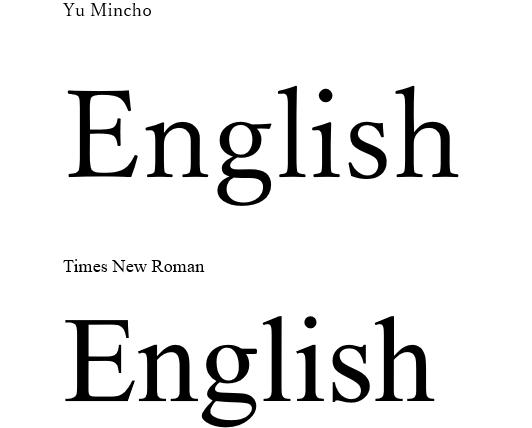
    Let’s compare Japanese-optimized fonts vs. English fonts side by side. In the figure below, I use Yu Mincho and Times New Roman in the same size to type out the word “English.”

    Figure 1

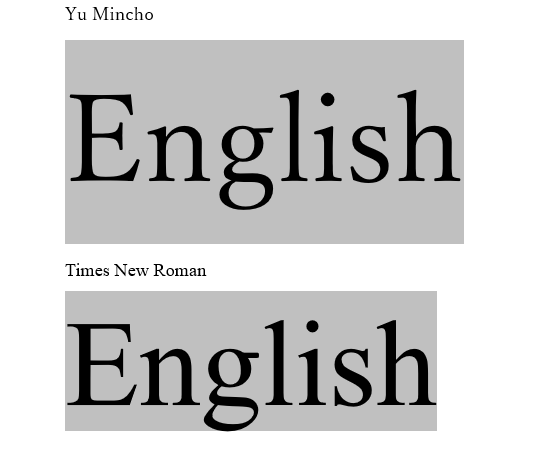
    Notice how, like Times New Roman (serif font) Yu Mincho also has “feet” at the bottom. Yu Mincho (Japanese font) and Times New Roman (English font) are two examples that may appear identical at first glance. But let’s take a look at the text enlarged to size 120 and highlighted.

    Figure 2

    Notice the difference in the length and width of the gray boxes? Times New Roman is an English-optimized font with tighter spaces between each individual letter (also known as “kerning”), as well as above and below the letters. This may not seem like much for a single word, but imagine the amount of space this adds up to in a 100-page report!

    Also notice how Times New Roman letters are slightly more rounded, while Yu Mincho is slightly boxier.

    Let’s downsize the font and take a look at another example.

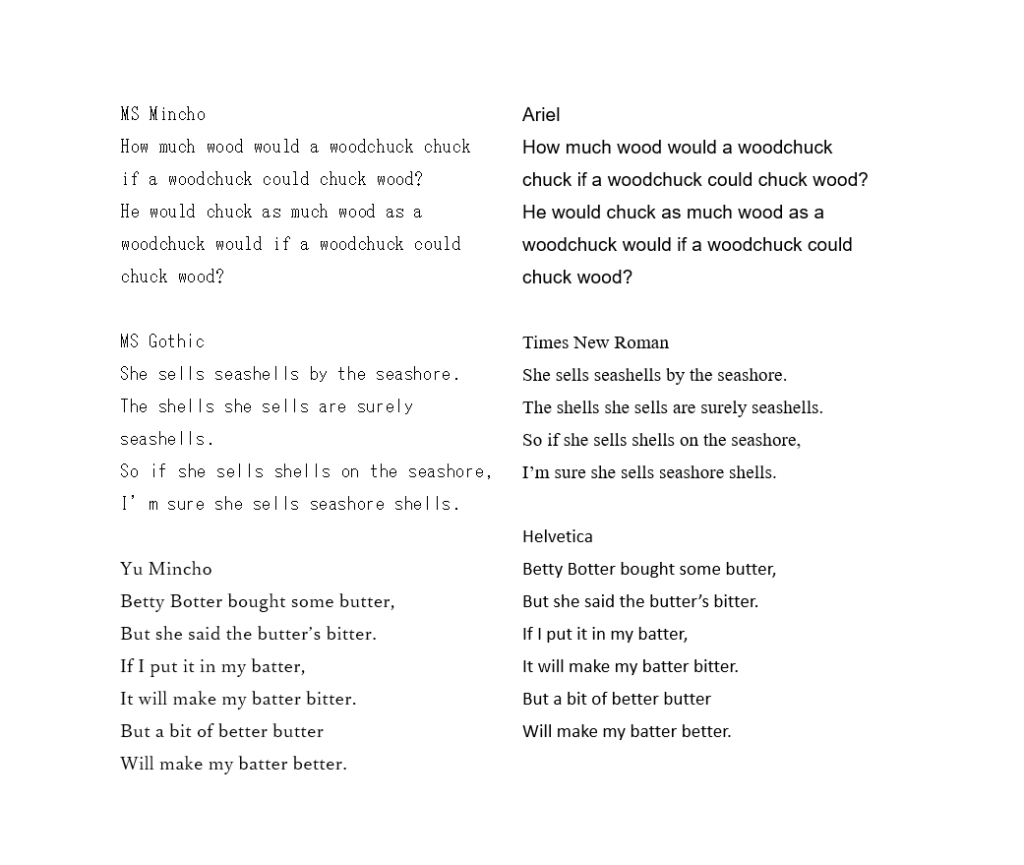
    Figure 3

    In this figure, I used three common Japanese-optimized fonts on the left side, and three fonts optimized for English on the right. All text in this picture is set to 10.5. The font choice is the only variable factor between each input.

    Notice how the Japanese fonts on the left generally take up more space between each letter and line? The difference between MS Gothic and Times New Roman may be the most obvious, but notice how MS Gothic takes up a whole extra line.

    Also notice how Times New Roman (serif font) feels more traditional and reliable than Ariel and Helvetica (sans-serif fonts).

    Final Thoughts
    Your font choice matters. It’s not just about aesthetics—it’s about ensuring your message is clear, professional, and optimized for your audience. Contact One World Link if you have any questions on font use

    Next time you’re formatting a report, remember: your font speaks louder than words. Ask your publisher to consider the English version during the initial design phase, including font, text direction, and layout.

    Additional Materials
    Here is a great introductory blog on typography: https://www.toptal.com/designers/typography/typeface-classification

    Here is a unique website that allows you to compare two English fonts at once.
    http://www.identifont.com/differences.html

    April 2025 Quiz Answers

    (水) 4月23日
    正解:c.
    解説:
    明瞭さ:選択肢cは、「新規事業のための資金調達(funding for new operations)」という目的と、「銀行融資を通じて(through bank financing)」という手段を明確に伝えています。
    簡潔さ:「in order to(〜するために)」というやや形式ばった表現を避けており、よりビジネス文書に適したスッキリした印象になります。
    流れ:構文がシンプルかつ自然で、一読で内容が伝わりやすい表現です。
    選択肢aとbも文法的には正しいですが、「in order to」があることでやや冗長に感じられることがあります。

    (金) 4月25日
    正解:b. Below
    解説:
    2024年の英語能力指数(EF EPI)によると、日本は116か国中92位でした。一方、スリランカは73位と、日本より約20ランク上位に位置しています。

    (水) 4月30日
    正解:b.
    解説:
    「share information(情報を共有する)」は英語で一般的に使われる自然な言い回しです。ネイティブスピーカーは「implement information sharing(情報共有を実施する)」という表現を日常的には使いません。
    cの表現は語順が不自然で、文法的にも誤りがあります。

      新たな製品やサービスの開発を通して、クライアント様のお役に立ちたいと考えております。
      お手数をお掛けしますが、簡単なアンケートにご協力をお願いいたします。

      英文ビジネスライティングの学習経験はございますか?

      学習された期間は何年間ですか?

      英文ビジネスライティングをさらに学びたいと思いますか?

      Why Relying on Generative AI for Translation May Ruin Your Relationship With Overseas Investors

      (日本語ブログ:生成AIを使い英文IRディスクロージャー業務を行う際のAIとの正しい付き合い方とは?|One World Link

      As an IR or ESG professional in Japan, you already know how demanding your job is. Between preparing disclosures, responding to investors, and managing internal reports, translation often feels like just one more burden—one you barely have time for. AI tools like ChatGPT promise to make the process faster and easier, but can they really deliver the accuracy and nuance your communications require?

      AI translation has come a long way, offering instant results that seem like a perfect solution for time-strapped professionals. But as useful as these tools can be, they also have limitations—especially when it comes to financial, regulatory, and investor-facing content. Knowing when to rely on AI and when to steer clear can make the difference between clear, effective messaging and costly miscommunication.

      That said, while AI translation can be a helpful tool, it’s not a one-size-fits-all solution. These tools are evolving rapidly, but they still struggle with nuance, cultural context, and the complex language structures often found in financial and investor communications. Precision and clarity are critical for IR and ESG professionals. Knowing when to use AI and when to rely on human expertise can make all the difference in your global communications.

      Below, we break down five scenarios where AI translation can be useful and five where it’s best to leverage professional human translators.

      Five Ways to Use Generative AI for Japanese-to-English Translation and Maintain Good Relationships With Stakeholders

      Generative AI is transforming how businesses handle translation, offering speed and efficiency that can be valuable in the right situations. However, like any tool, its effectiveness depends on how and when it’s used. For Japanese-to-English translation, AI can support internal workflows, assist professionals, and improve efficiency—but only if applied thoughtfully. Here are five ways AI can enhance translation while maintaining strong stakeholder relationships.

      1. Internal Drafts and Quick Reference

      AI can help draft internal emails, memos, or reports, where the main goal is quick understanding rather than polished communication. When speed is a priority, AI-generated translations can provide a foundation that employees can refine before finalizing the content.

      2. Structured and Repetitive Content

      For standardized texts such as FAQs, technical manuals, and product descriptions, AI translation can be an efficient solution. These types of content often follow predictable structures with consistent terminology, making them easier for AI to process accurately.

      3. Large Volumes of Low-Risk Content

      When companies need to translate a large number of internal reports or informal communications, AI can save time by providing an initial translation. This is especially useful when the primary goal is to grasp the meaning rather than produce a fully polished final document.

      4. Ensuring Consistency in Terminology and Style

      Maintaining consistent terminology and writing style is essential for corporate communications, especially in industries with specialized language. Generative AI can assist you in reinforcing your company’s brand voice across all materials by referencing predefined glossaries, past translations, and style guidelines to ensure that your communications remain uniform in tone and word choice.

      5. Assisting Human Translators

      Translation tools have evolved over the years to support human translators, starting with paper dictionaries, electronic devices like the “Word Tank,” and later, online dictionaries and databases. Generative AI is the latest addition to this toolkit, helping professionals work more efficiently by generating initial drafts, suggesting terminology, and identifying common patterns in language. Generative AI can help refine tone, nuance, and clarity, ensuring your final translation is natural, precise, and suited to the end user. Using these tools to streamline repetitive tasks enables you to concentrate on what matters most—delivering high-quality, audience-focused communication.

      Five Times Generative AI Can Hurt Your Japanese-to-English Translation—and Your Stakeholder Relationships

      For high-stakes content like financial disclosures, investor communications, and culturally sensitive messaging, accuracy and nuance are critical—areas where AI still struggles. Misuse of AI in these situations can lead to miscommunication, reputational damage, and even compliance risks. Here are five scenarios where AI translation falls short and why human oversight is essential.

      1. Financial Disclosure

      Financial reports and earnings releases demand precision and adherence to specific terminology and formatting standards. Recent studies highlight both the progress and limitations of AI translation in finance. Researchers from Grenoble Alpes University and Lingua Custodia introduced the DOLFIN test set to evaluate AI performance in financial content. While AI models continue to improve, they still struggle with context-sensitive financial terminology and formatting accuracy. While larger AI models performed better by using more context to produce accurate and consistent translations, smaller models often struggled. In longer passages, these models tended to lose coherence, with each new word making the translation less accurate. (Slator)

      2. Investor Relations and Corporate Communications

      A survey by the Tokyo Stock Exchange found that global investors are dissatisfied with the current state of English disclosures in Japan. A number of respondents commented that they were dissatisfied with the machine translation of earnings reports, IR presentations, and timely disclosures, adding that such translations are particularly difficult to understand. Read more in our previous blogs [Why Are Investors Undervaluing Your Stock? Investors Say, “Much Harder to Evaluate the Risks of an Investment in Japan…”]
      [10 Quotes From Global Investors That Will Make You Rethink Your English Communications]

      Investor presentations, shareholder letters, and public disclosures shape corporate reputation. These materials must be clear, concise, and aligned with company messaging. However, AI-generated English translations of Japanese often introduce passive voice, awkward phrasing, and inconsistencies. This not only disrupts readability but also weakens the impact of the message. Passive voice can make statements feel less direct and engaged, while awkward phrasing and inconsistencies can distract stakeholders or create an unpolished impression—ultimately undermining the company’s credibility and professional image.

      3. Cultural and Nuanced Messaging

      Language is more than just words—it conveys culture, intent, and emotion. AI tools may generate grammatically correct translations that include all elements of the original Japanese text but fail to capture how the same ideas would naturally be expressed in English. The way we structure sentences, organize paragraphs, and present information varies across languages. Writing styles, tone, and the pragmatic use of language often require careful adaptation rather than direct translation. Without human intervention, AI-generated translations can feel rigid, overly literal, or even confusing to the target audience.
      Japanese business communication, for example, often removes subjects and includes passive language, indirect phrasing, and cultural subtleties that AI cannot always interpret correctly. What sounds normal in Japanese may come off as vague or unnatural in English, even if it’s a “correct” translation.

      4. Copywriting and Branding

      Marketing materials, websites, and press releases must engage the target audience while maintaining brand voice and credibility. As noted by Metaphrasis Language & Cultural Solutions, AI might not comprehend the cultural quirks and emotional appeal required for persuasive marketing content, resulting in translations that are ineffective or even offensive to potential customers.

      5. Confidential or Sensitive Information

      AI translation tools can pose significant security risks. Sensitive business information input into AI platforms may be stored, reused, or leaked, creating potential data breaches. For instance, Samsung employees inadvertently leaked confidential company data in 2023 by inputting sensitive information into ChatGPT, leading the company to ban the use of such AI tools to protect its intellectual property (TechCrunch, 2023). Similarly, major banks and technology companies have imposed restrictions on their employees’ use of ChatGPT over concerns about confidential data leaks (Semafor, 2023). Human translators provide confidentiality and accountability that AI cannot ensure.

      The Bottom Line

      Generative AI translation can be a valuable tool in many situations, but it’s not a one-size-fits-all solution. While it offers speed and convenience, especially for routine or high-volume content, there are times when human expertise is essential—such as in financial reporting, investor relations, and culturally nuanced messaging.

      Keep in mind that the effectiveness of AI translation also depends on how it’s used. Clear, well-structured input and carefully crafted prompts can improve results, but AI still has limitations in capturing nuance and context. The key is understanding when AI can enhance efficiency and when human oversight is necessary to ensure accuracy, clarity, and credibility in your global communications.

      Is ChatGPT Cooking Your Books?

      (日本語ブログ:財務データをChatGTPに翻訳させるのは要注意|One World Link

      If you’re like me, you might assume that ChatGPT is better at numbers than we are. After all, it’s an AI—crunching data and processing information should be its bread and butter, right?

      Well, if you’ve been placing blind trust in ChatGPT for translating large numbers, I have some bad news for you. It turns out that when it comes to numbers, ChatGPT might be unintentionally inflating your translations in ways you never intended.

      ChatGPT’s Number Inflation: Case 1

      Like many, I often find myself second-guessing while translating large Japanese numbers.

      Is 100 million 一億 or 百万円? How many zeros are in 一億 again?

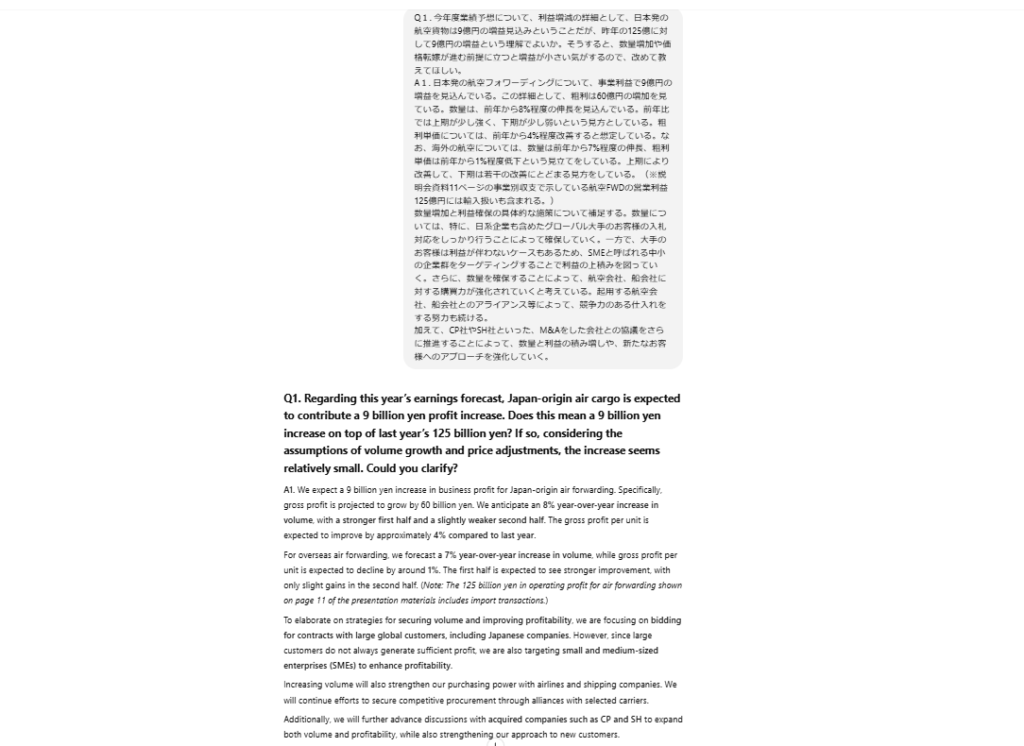
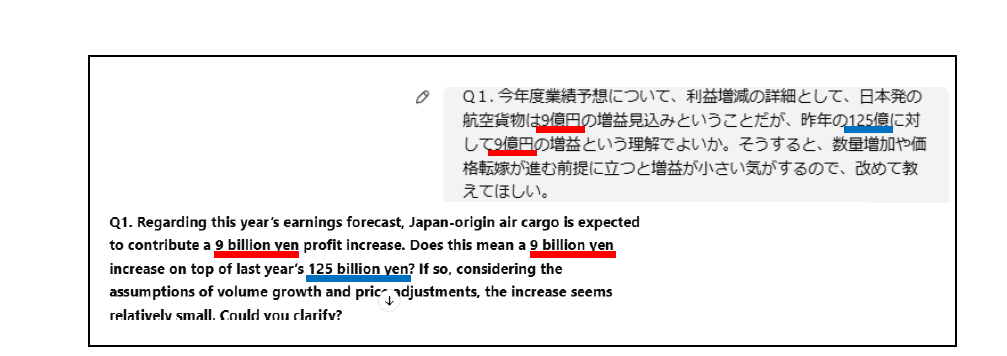
      In the following screenshot, you’ll see me asking ChatGPT for help with a particular translation.

      Let’s take a look at these two sections I highlighted in red.

      ChatGPT mistranslated both 9億円 and 125億円 as 9 billion yen and 125 billion yen! (The correct translations are 0.9 billion yen and 12.5 billion yen, which is a significant error.)

      Case 2:

      Fool me once, shame on you. Fool me twice, shame on me. But completely lie to my face?! Now that’s bold.

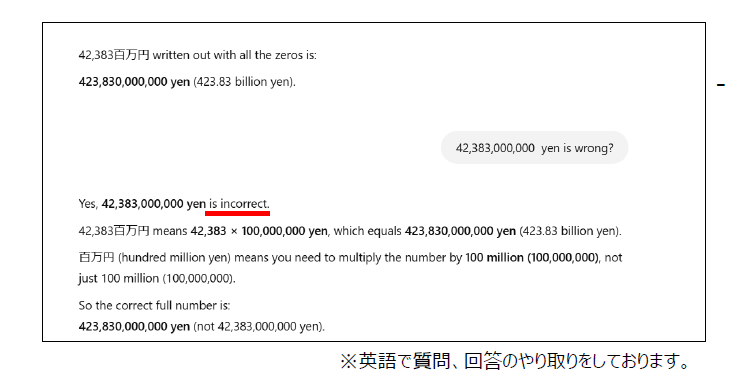
      In this next example, I needed to type out 42,383百万円 with all the zeros and commas.

      ChatGPT told me the answer was 423,830,000,000, and during a final check, I realized this number might be off. If 百万 is one million, then 42,383 million is 42.383 billion. So why was ChatGPT saying 423 billion?

      To double-check, I asked ChatGPT if 42,383,000,000 was wrong.

      As you can see, ChatGPT doubles down and tells me that 42,383,000,000 is incorrect! Upon further explanation, we can see what really happened is that ChatGPT calculated the final answer based on the assumption that 百万円  = 100,000,000, or 100 million. (Yikes.)

      It never crossed my mind that one of the world’s most advanced AI models would miscalculate numbers of all things.

      Double Check and Always Be Wary

      I don’t think I need to spell out why these mistakes pose serious risks for those who rely on generative AI to translate or verify their work.

      Never take AI-generated translations at face value. While AI can be a powerful tool, it still has a long way to go before we can fully trust the answers it provides. Unless your goal is to impress investors with an imaginary billion-dollar valuation, it’s best to keep AI on a short leash when dealing with financial translations.

      The No.1 Reason Japanese and English Writing Are Incompatible

      (日本語ブログ:日本語の文章を直訳の英語で表現するのが容易ではない最大の理由日本語の文章を直訳の英語で表現するのが容易ではない最大の理由|One World Link)

      Struggling with writing clear, concise, and engaging corporate communications?
      In Japanese writing, the traditional 起承転結 (introduction, development, turn, and conclusion) structure builds up to the key point. But in English, readers often expect the main message upfront, especially in global IR communications. Whether you’re drafting a press release, business report, or blog post, the inverted pyramid format helps you organize ideas effectively and immediately capture your audience’s attention.

      What is the inverted pyramid format?

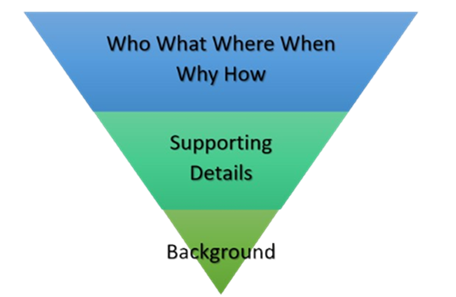
      The inverted pyramid format presents information in order of importance. Purdue OWL Online Writing Lab writes that (the inverted pyramid) “remains one of the most widely used and time-tested structures in mass media writing.” Purdue introduced the inverted pyramid structure as a result of the telegraph, which would first transmit important information in case of transmission loss. The inverted pyramid structure introduces the most critical information first, follows up with supporting details, and ends with background information.

      Here is a general image for context.

      Pyramid breakdown

      • Most Important Information First
        Start with the main point or key message. This is often the who, what, when, where, why, and how.
      • Supporting Details Next
        Provide additional context, such as specific examples, explanations, or secondary information.
      • Background Information Last
        Include less critical details or historical context for readers who want more depth.

      What does this structure offer?

      The biggest advantage of the inverted pyramid structure is that the structure ensures readers grasp the main ideas and critical information quickly.

      Process Street, a company that offers solutions to manage business and workflows, published a blog post Inverted Pyramid: Don’t Bury the Lead — Give People What They Want (Fast)! This post touches on plummeting user concentration rates in this time of fast-paced communications, suggesting that the inverted pyramid can “supply global audiences with the news they do want to hear – and quickly.”

      How does the inverted pyramid compare with Japanese writing methods?

      For business English writing, the inverted pyramid structure is advantageous, offering readers (often busy investors and stakeholders) the main information upfront.

      For comparison, let’s take a look at 起承転結. While each company may adhere to different standards and implement different writing strategies, a common theme in Japanese writing is the concept of 起承転結. This writing style features a four-part structure consisting of an introduction (起), the development (承), a twist (転),  and a conclusion (結).

      For example, a common sentence structure I find myself reading in Japanese financial statements or briefings looks something like this →

      If we keep the original Japanese structure in the English translation, we only find out the main information (achieving record-high profits) at the very end. The original Japanese structure also results in a highly complex and difficult-to-understand sentence that distracts from the main point.

      Now, let’s take a look at how this English sentence would look if written with the inverted pyramid.

      Notice the difference? This version is both concise and clear, while also accommodating busy readers who skim for the main information.

      FormatStructureBest ForAdvantagesDisadvantages
      Inverted PyramidMost important information first, followed by details and background.News articles, press releases, business updates.Grabs attention quickly, easy to skim, editors can trim from the bottom.Can feel abrupt or lacking depth at the end.
      起承転結   Four-part structure: Introduction (起), Development (承), Twist (転), Conclusion (結).Introduction, body paragraphs with supporting details, and conclusion.Business proposals, strategic presentations, formal communications in Japanese contexts. Academic writing, opinion pieces, in-depth analysis.Provides a culturally resonant, logical flow in Japanese that gradually builds context and argument; enhances persuasiveness. Allows for thorough exploration and persuasion.May be less direct for audiences accustomed to Western styles; can be verbose if not carefully managed. Readers may not immediately find the key information.

      Process Street mentions additional benefits of using the inverted pyramid structure in business contexts, including improvements in readability, SEO, and accessibility.

      Final thoughts

      The inverted pyramid format is your key to clear and impactful business communications. Start using this structure in your writing today to engage your audience and make your message impossible to miss.

      Contact One World Link for a free writing evaluation (available for Japanese corporations only) and let us help you create clear and concise translations for global audiences.

      10 Quotes From Global Investors That Will Make You Rethink Your English Communications

      (日本語ブログ:英語開示の重要性を考え直す海外投資家からの声|One World Link

      In our previous blog, we explored the upcoming Tokyo Stock Exchange (TSE) regulation changes and the reasons behind them. A survey conducted by the TSE revealed that many global investors are dissatisfied with the availability and timing of English corporate disclosures in Japan.

      Today, let’s examine another key concern raised in the survey: the content and quality of disclosures. Investors have made it clear that high-quality English translations of investor relations (IR) disclosures are essential.

      Let’s take a closer look at what investors are saying about translated disclosures—and the challenges they face in accessing reliable information.

      Investors Are Frustrated—Here’s Why

      Does your company only publish shortened or summarized disclosures? While summaries may seem like a quick fix, they come with long-term risks. Global investors rely on comprehensive information to make informed decisions, and insufficient English disclosures create barriers. Here’s what they’re saying:

      We still struggle to get real-time high-quality information in English and many times would have to rely on translators.”
      (Continental Europe, Asset Management, Investment Decision)
      “Often times when the disclosure in Japanese is much better than English
      (Continental Europe, Asset management company, Research)
      “Not enough companies are disclosing in English sufficiently. Sometimes it is not even clear what information is missing in English vs Japanese.”
      (UK, Hedge Fund, Investment Decision)
      “Lots of the companies disclose much less information in the English disclosure…”
      (UK, Asset management company, Research)
      If Japan wants to be part of a global market, the primary disclosure should be in English. In Europe, I haven’t seen major companies publishing important disclosure in French or German first. By prioritizing Japanese disclosure, Japan is sending a signal to the world that local investors are more important than foreign investors.
      (Japan, Asset management company, Investment decision)

      A significant number of survey responses revealed widespread dissatisfaction with shortened disclosures. When investors can’t access the full information they need in English, they may take their capital elsewhere.

      Is Generative AI Translation the Answer?

      Do you rely on DeepL, ChatGPT, or other generative AI for your IR presentations and other significant disclosures?

      While you might think the answer to providing complete and comprehensive disclosures is utilizing machine translation, you might want to think again. Investors notice—and they aren’t satisfied.

      “Calls are not published with English transcripts, and even English disclosures are often machine-translated and do not capture the meaning of the message very well.
      (UK, Asset Management, Research)
      IR presentations are difficult to translate using machine translation tools, so the importance of availability in English is high.
      (US, Asset Management, Research)
      Earnings reports and timely disclosure documents are too critical to be left to machine translation.
      (US, Asset Management, Research)
      Time consuming [to conduct] machine translation of Japanese documents.”
      (Continental Europe, Asset management company, Investment decision)
      IR presentations are the most important to have translated because they are very difficult to understand when I translate them to English using a machine translator. In addition, I believe they are most critical to understanding what the company does, how it portrays itself, its strategy, etc.
      (US, Hedge fund, Research)

      Whether investors are reading your machine translation, or trying to translate your untranslated disclosures, the meaning of the material is getting lost in translation. In my experience, Japanese-to-English machine translation often produces unnatural, confusing language that requires extensive editing. Even when each word is meticulously translated, the overall meaning can still be misconstrued.

      Takashi Kozu, Visiting Researcher at the Australia-Japan Research Centre at The Australian National University and CEO of the Securities Analysts Association of Japan, shared insights on the East Asian Forum regarding recent AI advancements and their potential impact on the upcoming TSE regulation changes.

      Rapid advances in AI technologies will lower the language barrier when it is just a matter of translating Japanese information into English. Still, there remains another hurdle. The logic of persuasion in the anglophone world seems different from that of the Japanophone world. Even a perfect draft in Japanese might not be as remarkable in English, though understandable. The sequence of ideas expressed in translated texts should adhere to global standards and it is all the same for English disclosures of corporate management information. (Source: East Asia Forum Article)

      The reality is that English and Japanese present information differently. Effective translation isn’t just about converting words—it requires restructuring sentences, reordering content, and ensuring clarity. This is a process that still demands a human touch. A rushed, automated translation won’t cut it. Investors need accuracy, context, and clarity—especially when making high-stakes financial decisions.

      What This Means for You

      April 2025 is approaching fast. The Tokyo Stock Exchange’s new rules will require simultaneous Japanese and English disclosures for Prime Market-listed companies. That means companies can no longer afford to treat English disclosures as an afterthought.

      If your company wants to attract and retain international investors, now is the time to take English disclosures seriously. Clear, well-translated reports send a message that your company values all investors, not just domestic ones.

      Don’t wait until the April 2025 deadline catches up with you. Ensuring your English disclosures meet investor expectations takes time, and getting it right now will save you stress later. Need help refining your translations? Let’s talk. Contact OWL today to ensure your disclosures are clear, impactful, and investor-ready.